
By the late 1960s, when I began working as a student-worker at the Polynesian Cultural Center, the late Uncle David Hannemann introduced me to one of his village innovations that may have had far-reaching effects:
Adding live chickens: I can still see him in my mind, coming around the Samoan Village on a late afternoon, grabbing a cup or two of leftover coconut shreddings (that had been squeezed dry of coconut “milk” or oil) from the umu kuka (kitchen) area cooking demonstration.
Uncle David would then walk over to the malae (village green) and start to make loud “coo-coo-cooing” sounds while spreading the shredded coconut on the ground.
He explained to me this was how families in Sāmoa trained chickens to come to the same place every day to get fed. Sure enough, all the chickens he had placed in the villages quickly came and started pecking at the shredded coconut.
Since then, feral chickens have literally spread everywhere across Oahu. I’m not saying the Polynesian Cultural Center chicken experiment had anything to do with that, but there are still chickens everywhere to this very day.
Polynesian dogs: It is fairly well known that the old Polynesians kept dogs both as pets and as food. So, as part of the “animal experiment” at the Center, Uncle David did some research and came up with a kind of mixed-breed dog that people at the time thought was the closest to what ancient Polynesians might have brought with them on their canoe migrations. I don’t remember the dog experiment lasting very long.
Pua’a (pigs): For sure, pigs were a very important source of protein in old Polynesia, and at one point Uncle David had the Sāmoan village set up a caged pig display. This part of the animal experiment also didn’t last very long, because the pig quickly started to get a little messy and way too smelly.
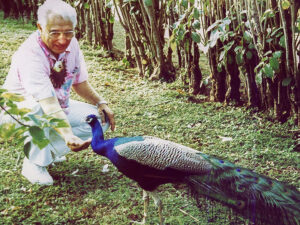
Peacocks and hens: I think it might have been Ralph Rodgers Jr., PCC president during the 1980s (although this might have been another Uncle David Hannemann innovation), who introduced live peacocks and hens to the villages. At one time, I know there were three or four of them, and yes, the males would occasionally display their dominance by typically fanning their tail feathers, but only when they wanted to (even though guests thought they would spread their tail feathers all the time).
These larger birds were certainly colorful, but it turned out they were also very territorial and sometimes not willing to move for visitors. They came and went wherever they wanted, but the focus of this memory is when they roosted in one of the PCC trees every night. Then they got very LOUD.
Oh sure, they sometimes called out during the daytime, but for hours after they roosted, their loud calls could be heard all over the PCC end of Laie.
I’m not sure when the last one left, but I would be surprised if anyone missed them. Likewise, to my knowledge, I don’t think there have been any other animal experiments at PCC since, unless someone counts the fish or prawns in the lagoon.