
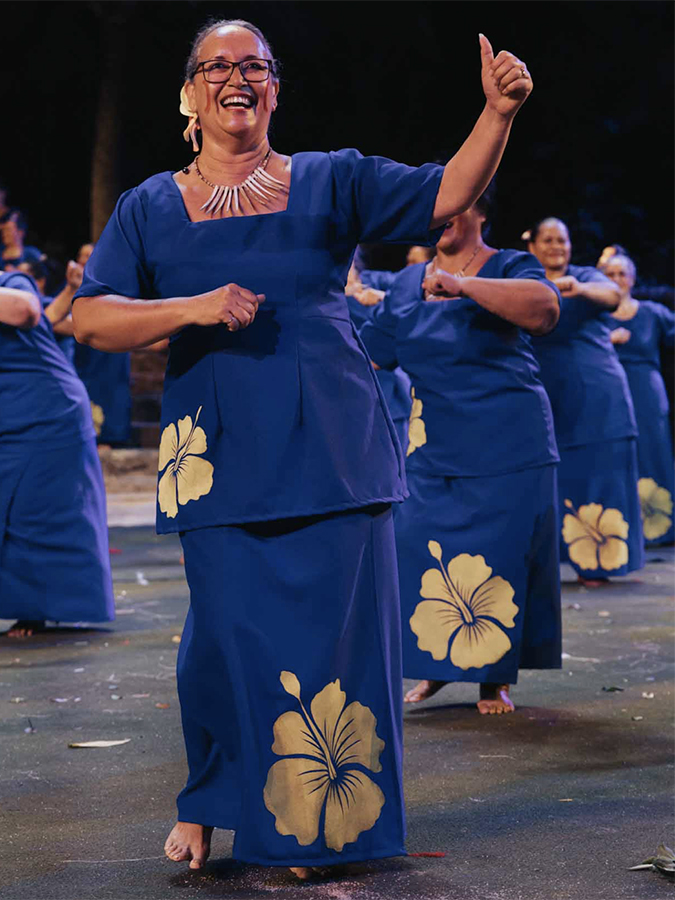
Delsa Atoa Moe, 66, Polynesian Cultural Center Vice President of Cultural Presentations since 2015, might have surprised some people when she announced earlier in 2026 at the 34th annual PCC World Fireknife Competition that she planned to retire at the end of this year, but she said she had been thinking about it since before she turned 65.
After all, with 48 years of outstanding service to the Center, it’s believed only Silina Turaga Aina, a weaver in the Hawaiian Village who literally grew up on the grounds, has continuously worked here longer.
Born and raised in Sāmoa: Delsa — who is named after Delsa Hatch, her father‘s “hānai mom” — is the eldest among her four siblings, and was born and raised in Sāmoa. Her father, the late Tufuga Samuelu Atoa, was a high chief, former government official, businessman, Samoa amateur sports executive, and a prominent Latter-day Saint leader for many years. Her mother, Helen Evans Atoa from Blackfoot, Idaho, served as a missionary in Sāmoa in the middle 1950s, met the handsome Sam in California while he was working over a summer break at BYU, and… the couple moved to Sāmoa soon after getting married.
The elder Atoa passed away in 1998 but her 94-year-old mother Helen now lives with the extended Moe family in Laie. She spent over 40 years working as a teacher, office assistant, and librarian and in Sāmoa and is widely known by thousands of CCWS and Pesega school alumni. She is still actively involved with her 50-plus descendants in Laie and the U.S. mainland, and still teaches gospel doctrine in her ward Sunday School.
Delsa has held her familyʻs high talking chief title Tagaloataoa since from Savai‘i since 2017 and is active in extended family affairs. In Sāmoan matai culture, most traditional leaders usually act as either a high chief (ali‘i) or a talking chief (tūlāfale) who holds a particularly significant title and often represents a particular area of authority.
The Lotopā girl becomes a teenage Polynesian performer: “Growing up in Lotopā (near Apia), right next to Pesega, many of my school teachers were Church College of Hawaii (renamed BYU–Hawaii in 1974) graduates and PCC alumni,” Moe said. “One in particular, Beth Hunt [widow of the late Tevaseu Sola George Hunt, also a PCC alum], started up a little neighborhood Polynesian dance class. I must have been about maybe 14 at the time.”
“Many of us neighborhood kids went to dance, and we really enjoyed it. She taught us how to do Māori poi balls, Hawaiian hula, and a little bit of Tahitian, but mostly it was Hawaii, Aotearoa, and Sāmoa. That was my first taste of performing those other Polynesian dances, and I really enjoyed it.”
Making college plans: “As I got closer to graduating from high school in December 1977 and trying to decide where I was going to go to college, my dad was a BYU Provo alum, so of course, naturally, he wanted me to go to Provo. My mom graduated from Ricks College, now BYU Idaho, so she wanted me to go to BYU Idaho. Also, my grandparents lived in nearby Blackfoot.”
“BYU–Hawaii wasn’t really an immediate desire for me. So, in 1976 it was going to either be Idaho or Utah,” Moe continued, “but then I was invited to participate in an art competition. Back then, we had the New Era church magazine for youth, which held an annual art competition, and Brian Kelly, the managing director, had come to Sāmoa on church business. I think he stayed with us.”
“He saw that I did tapa art. That was a hobby my friends and I did. I would do commissioned pieces, and that’s how I earned money on the side. He suggested I enter this church-wide art competition for youth. So I did, and I ended up winning a special award, a scholarship to any of the church schools. Around that time, because of my high school grades, I received an academic scholarship to BYU–Hawaii. With free tuition for the first semester, and what I received for the art award, I decided to go to BYU–Hawaii for a year and then go on to Provo.”
Delsa‘s first PCC job, the Māori village: “Before checking into the dorms, I stayed with the [the late] Larry Oler family. He and my mom had been missionaries at the same time in Sāmoa, and their oldest daughter, Lani Oler (who was Sāmoan), worked in the Māori Village.”
“I would go to work with her and hang out in the Maori Village. Uncle John Elkington, who was the chief, noticed me and asked what I was doing. When he found out I was going to be a student, he asked, ‘Do you have a job?’ And I said, “No, not yet.” ‘Do you want to work in the Maori Village?’ “And I said, “Yeah. I didn’t know what else there was, but I’d made friends with the village kids already, and I was familiar with them. So he hired me. “That was my very first PCC job.”
“I loved working in the Māori village. We had some great people there, the likes of Edwin Nepia, Grant Pierce, and incidentally Ottley and Celia Hawea. Sheʻs now a cultural senior missionary at the Center. Our kaumātua in the village at the time were Auntie Rose Barlow, Auntie Rakapā Sturm, Uncle Tommy Taurima, Doe Horomona, and of course Uncle Johnand Auntie Wai Elkington. It was a great place to work that lasted a semester.”
Up next playing the pump organ in the matinee PCC brass band bells: “Then the Theater department came calling,” Delsa said. “That was when we had the matinee show in the Hale Aloha. Esther Dela Rosa had been very involved with that, but she was leaving, and they needed somebody who could play the foot-pump organ for the Pacific choir numbers and a keyboard player in general. I thought, what the heck, and I transferred. In those days, there were no limits to the number of hours a student could work. Most of the international and domestic students were working full 40-hour weeks and attending school full-time.”
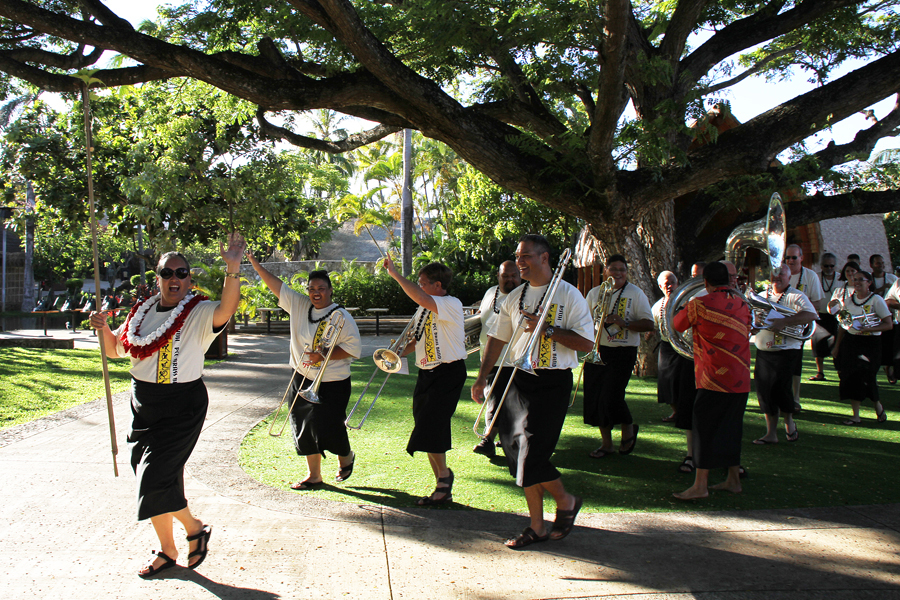
“That was my introduction to the theater department. I worked the matinee show, which also had a brass band that played in the evenings. Sione Tu‘itupou, one of the matinee show managers had been my band teacher in Sāmoa, and knew I could play the bells. I had also played woodwinds in Pesega, but the brass band didn’t use that, and I ended up also being the band librarian, because I had done that in high school, too. I also cleaned instruments and wrote music for Sione, doing that for quite a few years.”
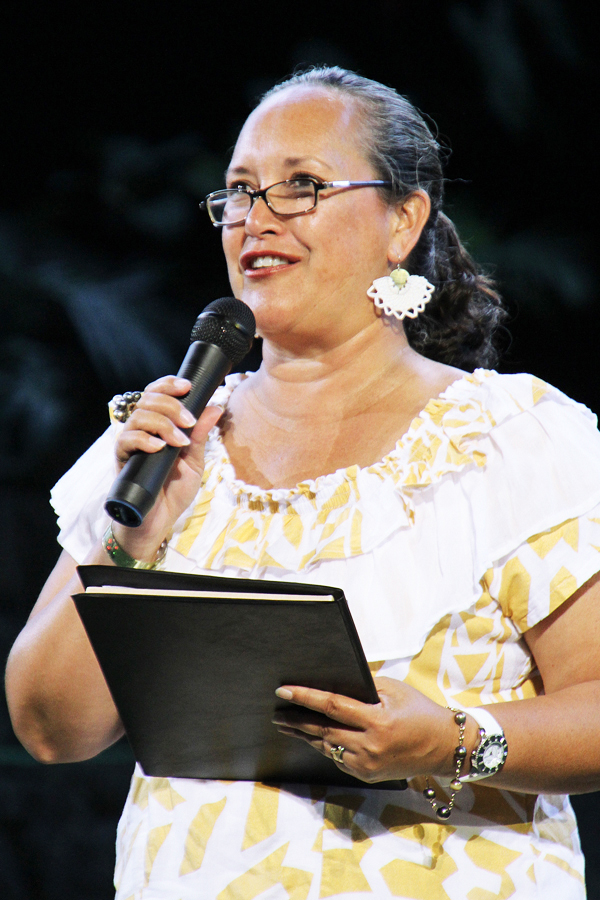
Becoming a PCC emcee: Moe also got her start as a popular PCC emcee while working in the matinee show when it needed some narrators. “There were four of us: Steve Lāulu was working at the time, Justin Uale, and Oli Tuiā when Jack Uale asked if I was interested in also being a narrator for the show. That’s when I started narrating there and developing that talent.”
“About that time, the (mid-afternoon) Canoe Pageant had speakers on each canoe that would play the music for that culture, but there was no live narration. However, when the theater department decided they needed to go back having some live narration to explain what was going on, they wanted emcees very quickly.”
“I remember they told the four of us then narrating the matinee show, ‘You guys are going to be the Canoe Pageant narrators.’ By that time, Justin was still there, myself, and Bonnie Rogde Berryman, but I forget who the other one was.” But Moe remembers there was no script. She and the others were told, ‘Just come up with something.’ “We all just laughed and said, “What are we going to say?”
“We each developed a script on our own and went out there and basically winged it. Back then, there were two areas where they had narrators, up by Tahiti and over by Samoa, and we just basically paired up. Two of us in one area, two in the other area, and we’d take turns.”
“That was my introduction to Canoe Pageant as a narrator, and then eventually I wanted to do something else, and so I learned the dancing for the Hawaii, Tahiti, and Samoan canoes.
Very Busy ‘working four jobs‘: “When I wasn’t narrating, I would be dancing on one of those canoes. Then I was in the brass band concert in the evening. We’d start out with the ‘Sunset Parade’ at 5, marching and playing our way through the villages, and then we’d put on a concert on the backside of what is now the Gateway Kitchen; and if you can believe it, eventually I thought, why not try out for night show as well?”
“The brass band concert ended about 6:30, and after that the guests started moving toward the Pacific Theater; so I decided to audition for the night show, too, but I think I didn’t pass the first time. I had to audition twice.”
“When I finally got picked up in the night show, I danced Hawaii, Maori, Tahiti, and Samoan. I was pretty much working four jobs and going to school full-time.”
“Eventually, the Theater department retired the matinee show, and then later on, they also decided to do away with the brass band. [By then, the band had been turned over to the BYUH Music department, although the PCC paid their wages.] At that point, I was just doing Canoe Pageant and night show.”
“I think I was also supervisor over the narrators. And then about that time, I was nearing graduation from BYU–Hawaii. Yeah, so other than my very first semester working in the Maori village, the rest of my college life, I was working somewhere in the Theater department.”
Meanwhile, attending BYU–Hawaii and changing majors: “When I first enrolled, I thought I would be a biology major, until I learned I actually had to dissect a frog,” Delsa recalled. “We didn’t have frogs in Western Sāmoa, and I thought they were just gross and couldn’t think of dissecting one, let alone touching one.”
“So I changed to a music major,” Moe said, but she quickly discovered that while she enjoyed playing music, she did not like music theory classes. And I thought, Oh my gosh.”
“Okay, then I switched to graphic design, because I really enjoyed art. So I dabbled in that, but I was intimidated by the level of skill some of the art majors had. I thought, oh my gosh. There’s no way I can compete with that. Then somebody convinced me — I can’t remember who — to take a travel class from Brother Gerry Bohnet.”
“By this time, I was entering my junior year, and I was still an undeclared major, when I went to Brother Bohnet’s class and was learning about all these different cities and countries. I loved it, and I took the next class the next semester. After that, I finally went to my advisement aide, and I said, I’m going to major in travel.”
Moe reports she thoroughly enjoyed everything except taking statistics from Brother David Miles, which even though her final grade was lower than usual, she was happy to pass. “I was so happy I passed the class and didnʻt have to repeat it. That was the worst grade I got my entire college career, but it felt like an A.”
Student life at BYUH: Moe said she also enjoyed lots of other things about BYUH student life, including the clubs, cultural night shows, and choir festivals.
“Living in the dorms was also so fun. My first dorm mom was Sheila Ālō. Sheila was actually my real auntie, so that was nice. That was also my first time living away from home and going through culture shock, so it was good to know I had an auntie I could just go to her apartment and know I was with family.”
“I had Mom McDermott when I was in Hale One. You either hated her or you loved her. Yeah, she was very strict, but she had a big heart, and I loved her.
“I also loved being with my BYUH 7th Ward ‘family.’ [The late] Lance Chase was my first bishop, and then he ended up being my Laie 2nd Ward bishop again after Paki Moe and I got married in 1982.”
“Paki and I had at BYUH during my first semester, but we didnʻt start dating until a couple of years later. We now have five children — four sons and one daughter — and 10 extraordinary grandchildren.”
Moe graduates in Travel Tourism Management in 1983: “PCC offered me a full-time job right after graduation as co-manager with Raymond Mokiao over the Guides department. We worked together for two years, then I was asked to co-manage the Theater department with Brian Bowles.”
“The two of us managed the Theater department for two years, and then I was asked to go back to the Guides department, which I managed alone this time for two years.
Sales and marketing team, and Sterling Scholar, and more: The PCC transferred Moe to work in the incentive/convention markets on the sales and marketing team in 1988. “In 1989, I was also asked to be involved with the PCC’s former Sterling Scholar and Teacher of the Year programs. (Under the former program, inspired by a similar one in Utah, the Center and other sponsors awarded scholarships to outstanding Hawaii high school graduates in about a dozen different categories until the program was eventually discontinued.
The PCC also eventually assigned Moe to take over military sales, which meant she regularly divided her time between Waikiki, Laie, and driving around to all the various military sales points on Oahu.
“I can’t remember which child I gave birth to,” Moe said, “but anyway, I felt commuting was just too hard on my pregnant body, and I proposed to [the late] Vernice (Pere) Wineera, our sales and marketing vice president at that time, what if I still worked in sales, but I mostly worked from Laie?
“Teryl Pere Soren would do the groups and incentive selling, and once she closed the sale, I would handle all site inspections and arrangements when a group actually came out to PCC. It worked out great, and that’s how our on-site sales coordinator job came to be. We still have it to this day. I was also asked to take over Reservations at one point. Then in 1994 I was also asked to temporary manage Reservations.”
From sales to cultural presentations: “I did that for about a year,” Moe continued, “until Andy Macatiag was hired as the Reservations manager, and from there, I was appointed director of the Theater department, just as we launched the Horizons night show.
“In 1999, the PCC promoted me to Director of Cultural Presentations, and when Logo Apelu retired in 2015, I became Vice President of Cultural Presentations until the present day — 48 years after accepting my first student job at Māori Village. “
What are her top-of-mind PCC memories: “I’d have to say they were not a single event, but a series of events. For example, people-wise, I have to list:
• “The opportunity to meet Church prophets who have come through PCC, starting from President Spencer W. Kimball, President Howard W. Hunter, and every single prophet after that. Of course, I’ve also been able to meet many of the apostles and other general authorities.”
“We are just so, so blessed to meet these wonderful leaders. In my capacity as a host, I have been able to shake their hands and speak to them.”
• “Then, of course, there have been many iconic celebrities and world leaders,” Moe added. “I remember the time somebody ran backstage and said, ‘Hey, Engelbert Humperdinck is here.’ “And I go, what? I think he was the first big celebrity I remember. I didn’t meet him, but saw him and his family when they were just resting on a little hill outside the Pacific Theatre, waiting for the show to start. That was in the days before we had cell phones, and we didn’t really bring Instamatic cameras to work.”
“I also remember Saleva‘a Atisinoe, originally a Sāmoan from Wai‘anae when he was at the height of his sumo career in Japan; and Benjamin Netanyahu came through once, but that was at a time he was in between elections and not the prime minister of Israel.”
“Of course, Seiuli Dwayne Johnson — the Rock — has recently been to the Center three times, and lots of Polynesian Football Hall of Fame stars, too.”
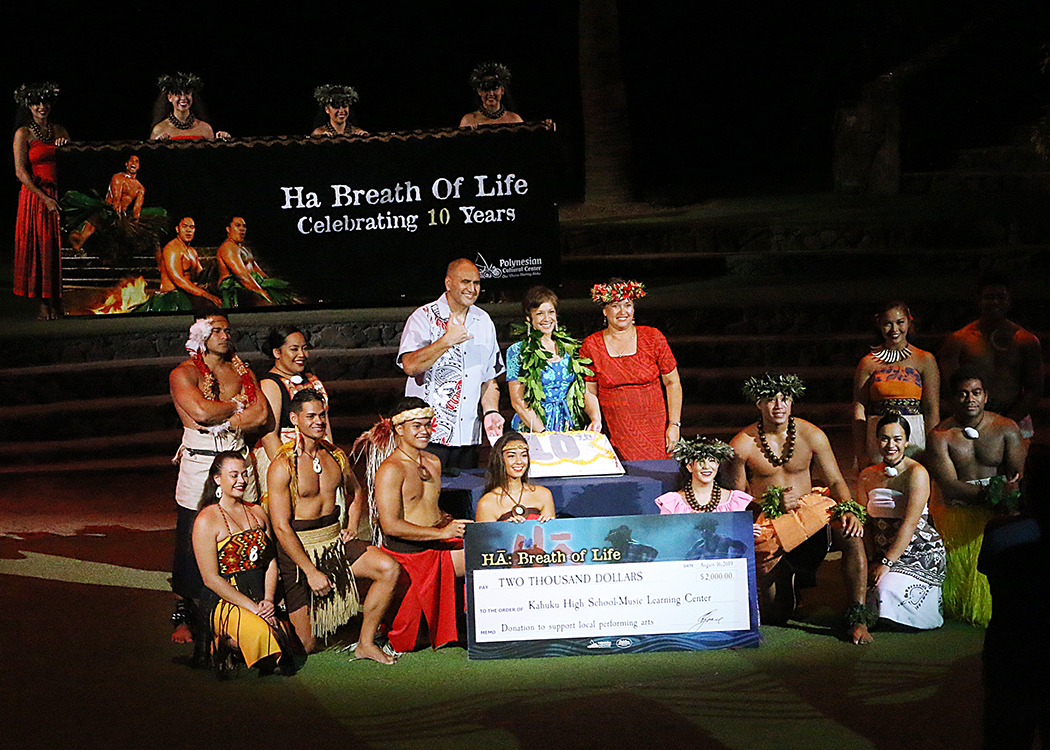
• “In terms of events, one of the highlights of my career is being involved with our night show, Hā: Breath of Life. Thatʻs been a huge undertaking for the past 17 years, but I’ve learned so much from that experience. We premiered that show on August 8, 2009, and it’s still going strong with high satisfaction ratings.”
• Moe also singled out two related, “pivotal highlight experiences, ” including the investiture ceremonies when the Sāmoan Head of State Mālietoa bestowed the chiefly title Galumalemana and King Tupou IV of Tonga named then-PCC President Lester W.B. Moore Mafifakapotu.
“Those were monumental events, and I was so humbled to play a role in them.”
• She also added that some of her “favorite mentors over the years included Keith Awai, the late Vai Fa‘amaligi, Jack Uale, and Logo Apelu. Logo was my high school teacher, and then he became my boss here at PCC. We would always joke, we can’t escape this guy, but I learned so much from him.”
“I also want to list Auntie Sally Wood Naluai. I didn’t get to work with Auntie Sally as much as I would’ve liked to, but the times she came and conducted our rehearsals, I was just in awe of her spirit. Her mana was just so powerful.”
“There were so many other great people I learned from, too, including Erena Mapuhi and Uncle Tommy Taurima, a funny, funny guy who was also my neighbor.”
Moe added, “We also have phenomenal leaders today. They are so competent in what they do, and I enjoy working with them.”
Did Aunty Delsa ever think of working elsewhere? Years ago, I thought PCC was perhaps a stepping stone to another job, and I have had some offers made to me from Utah, but I just can’t imagine myself living there. I’ve been very happy at the PCC.”
“I’ve been able to work so close to home, for a wonderful organization that has the same values and beliefs I do, and the Center has been very supportive of us mothers: If we ever needed to stay home with a sick child or go to a school ‘Super Citizen’ program, PCC always supported those things. How many companies are like that? It’s been such a great blessing to work for an organization that supports families and understands their important to employees and their families.”
On the road for PCC: In her various theater, sales, and cultural presentations assignments, Moe has also frequently traveled for the Center. “I remember going to New York City for the very first time “when we accompanied Hawaii Governor George Ariyoshi to do a special promotion in the Lincoln Center. I fell in love with New York City then.”
“Then we went back, a year or two later, for the grand opening of the Marriott Marquis Hotel on Times Square. That was a huge opportunity, and we were hosted by Bill and Dick Marriott.“
She added she was also part of PCC promo groups that helped the former America West Airlines open its New York office. Of that trip, she remembers putting on a mini-performance at the main branch of the New York City library, where they had to rig a temporary dressing room out of lavalavas behind one of the famous lion statues. She returned again to the Big Apple in 1986 for the PCC’s participation in the Aloha Liberty campaign.
“I also went with Governor Ariyoshi and a Hawaii group to Okinawa, Japan, when he signed a sister-city agreement there. I’d have to say Okinawa was probably a most unusual place for me to visit because it looked so much like Sāmoa.”
While traveling for PCC seems it could be exciting, Moe pointed out a lot of their trips were also “quick and trying.” For example, her PCC group got delayed one time in St. Louis, Missouri, when Tolo Fiso was one of our musicians, “so we just started entertaining right there in the airport, and people forgot about complaining/ They got this little impromptu show. Some of those guys, Sielu Avea and So‘o Tufaga were just natural clowns. I think Keenan Kanahele was also part of that group.”
“The airline was so appreciative when we finally boarded, that they upgraded our leaders to whatever first-class seats they had available.”
What does Moe plan to do in retirement? “First and foremost, I want to get my house built. We’ve been trying to get it built for years, but work just got in the way, and these things take time to plan, apply for a loan, meet with an architect and designers to get all the ideas in my head down on paper. Then, you know, here in Hawaii, it takes forever to get building permits.”
Parting thoughts: “I’ve really enjoyed seeing the growth of different things at the Center, such as all the physical changes. When I first got here, the Pacific Theater was practically brand new. It opened in ’76, and I arrived in ’78.”
“During my early days, we also saw the building of the Hawaiian Journey Theatre, which required us to move the Tongan village from where it was to its current location. Then PCC moved the Hawaiian Village (from approximately where the Mission Settlement is), and that whole area was expanded up there to where Tahiti and Hawaii now are, and we have big plans for more changes in that area that will focus more attention on the Iosepa canoe.”
Moe also singled out seeing the start and growth of the late Pulefano Galea‘i‘s ideas for the World Fireknife Championship and We Are Samoa Festival — now in their 34th year. “They remain hugely popular, and I really enjoyed working on those things and seeing all the leadership changes.
She said some of product and program changes have “been hard, and some we’ve had to endure, but most of it has been good and exciting to experience. One of the thing I’ve enjoyed most is watching our people grow, whether they were students or community, just seeing them come in shy, timid, and inexperienced; and then they learn new skills and become great at what they do and confident as individuals.”
“We have seen so many students graduate and move on, and just continue to soar. When we see some of these PCC alumni come back and hear what they’re doing in their lives, it just makes us so proud to have been involved in their development and growth.”
“I really appreciate hearing alumni say they are successful because of the experience they gained at the PCC.” Some say, ‘This is where I learned my skills.ʻ That’s what I enjoy the most, seeing them fulfill David O. McKay’s vision at BYU–Hawaii, because we really are an extension of the university.”
Parting advice to colleagues: To her colleagues and future successors, Moe said, “Be you, with your own set of skills, talents, gifts, and vision. Don’t try to do what I did. Whoever that’s going to be, they’re going to come into this position with their own set of skills and talents and gifts and vision.”
“I’m optimistic about the future of PCC. We’re solid now that we’ve got the mission in place, and we’ve received direction from our leaders as to what we should be doing.”
“When we closed for COVID, the PCC could possibly have closed down for good. That would’ve been a perfect time for the Church to say it’s been a good, 50-something-year run, but they didn’t. They want PCC to remain open. That’s a huge affirmation of the PCC’s role in the Lord’s plan. And when He decides PCC is no longer needed, we will get that message.”
“We’ve had prophets come through and continue to be supportive of what we do and provide direction, and it’s so comforting to know we have that. We are here to spread aloha around the world. We do that with our Polynesian culture, with just who we are, and people don’t forget that.”
“They don’t forget our kindness, and when they find out that we’re owned and operated by The Church of Jesus Christ of Latter-day Saints, for most our guests, it’s like, ‘Wow, that’s nice. Didn’t know that.’ It softens their hearts and makes us love this place even more.”
Parting advice to student-workers: “We usually share advice like the following with our graduating students every semester,” Moe said. Make the most of this opportunity. You don’t know what a huge opportunity you have right now.”
“The real value of PCC becomes evident when people leave. So many times, I’ve had people comment, ‘PCC was my best job ever,’ and these have been very successful people. They said, ‘I would give up what I’m doing now to come back and work for $2. That’s what our paychecks used to be [after paying off educational loans] when I started as a student.”
“So many wonderful people have loved their time here at PCC. Naturally, sometimes when you’re in the middle of it, it feels like a job. It can be mundane at times, but when you leave, then you realize you received so many lessons here.”
“We try to instill the PCC’s mission in each employee. If you’re just doing this because it’s a job, it won’t be as rewarding for you, but when they understand how they are helping to fill this mission, then their whole outlook changes. They see the blessings and the benefits, not only for them, but for all our guests, too.”
A lasting legacy: Moe added she’s “very grateful my siblings and kids have been able to work at PCC and experience things that have helped them in their lives, and I hope my grandkids will grow into roles here, too. My oldest granddaughter is going to be a senior this coming school year, and hopefully, she’ll want to come and work somewhere at PCC because it’s a great place to develop confidence and presentation skills in talking to people.”
“I hope all of our employees recognize how much PCC has been a blessing to them, not just through employment, but as a place where they can come visit and learn about the different cultures.”
“I also want to thank my husband, Paki, who‘s been my quiet supporter all these years and has frequently watched all our kids so I could be here for the big events that required many long hours.”
Post-script: Moe has received many honors over the years, the most recent one on her birthday, July 5, 2026, at the Hilton Hawaiian Village ballroom in Waikiki when Honolulu-based Radio International Samoa, celebrated its 40th anniversary by recognizing 40 outstanding Sāmoan individuals who Aiono Ken Sataraka has interviewed over those 40 years, including Tagaloataoa Delsa Moe.
“I’m still a little baffled as to how I made that list,” she said modestly, “but I’m also honored and humbled because it also brings recognition to PCC. Being there and listening to these individuals and their accomplishments, it was amazing. One of them was my own cousin, Lelei lelāulu, a renowned development entrepreneur who was nominated for a Nobel Peace Prize last year.”
Moe said others among the 40 included PCC alumni retired Hawaii Family Court Judge Bode Uale and retired US Air Force Colonel Stan Snow. More recently, Snow was also a long-time pilot for United Airlines and head of the pilots union.
“And another one was Faith Thompson Ako, a Nā Hōkū Hanohano winner who is originally from Laie, “and my husband’s classmate. She’s always been a really good friend on his.”
“To have people like this recognized in such a public way for their accomplishments, it was just wow.”
Author Mikaele Foley, who remembers Moeʻs parents in Sāmoa 60 years ago (and Delsa was only a young girl) adds A BIG FA’AFETAI TELE LAVA to Tagaloataoa Delsa Moe for her many years and uncountable contributions to the Polynesian Cultural Center. SOIFUA FUALOA.
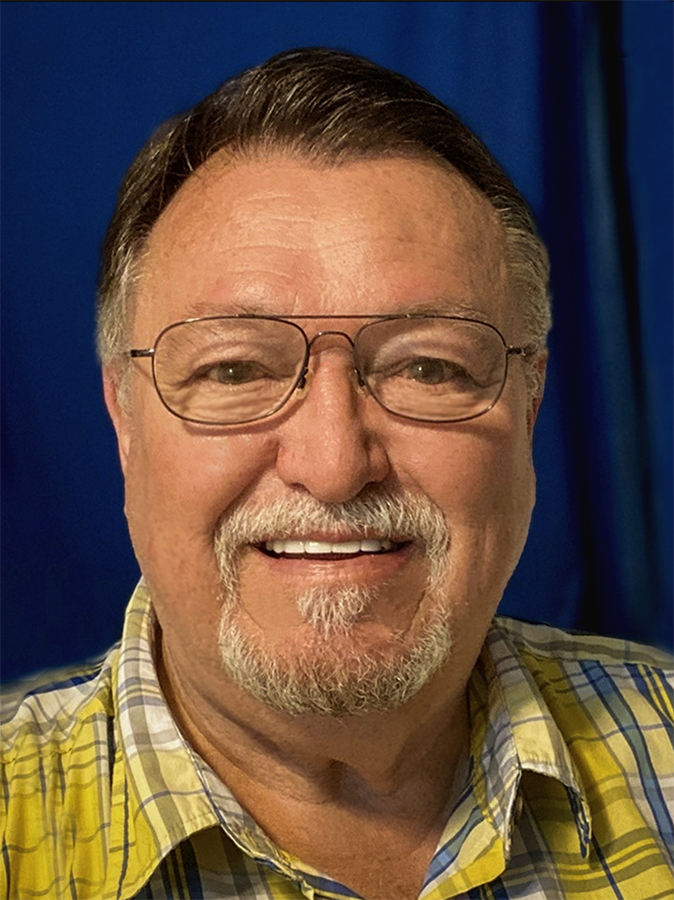
Mike Foley, who also goes by his Sāmoan and Hawaiian name Mikaele, first visited the Polynesian Cultural Center on his way home from serving 2.5 years in the Latter-day Saint Samoa Apia Mission. A few months later, he returned to Laie to enroll at the Church College of Hawaii and soon got a student job at the Center. He has worked intermittently at the Center ever since, now more than 60-ish years, including about 25 years full-time in marketing communications, PR and advertising. During the earliest of those years, he met and married Sally Ann McShane, a beautiful young Hawaiian dancer (who came to Laie from Waimalu, Oahu, in 1963 although her mother's Hawaiian ancestors come from the Big Island). They raised their family in Laie and still live there.
Your comment has been submitted for administrator approval.
Your comment was not saved. Please try again.
No comments yet.