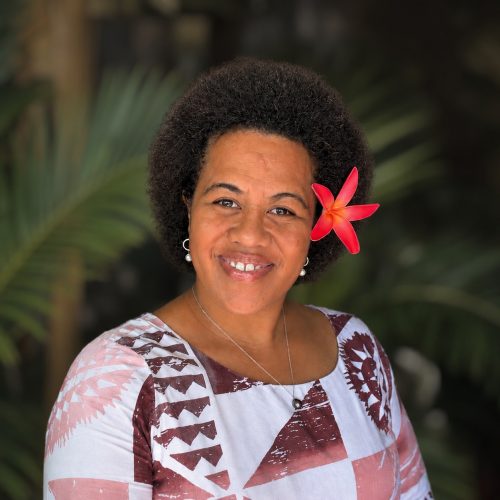
(Grace is a friend and colleague through work at the PCC on Legacy.Polynesia.com for the last 18 months.)

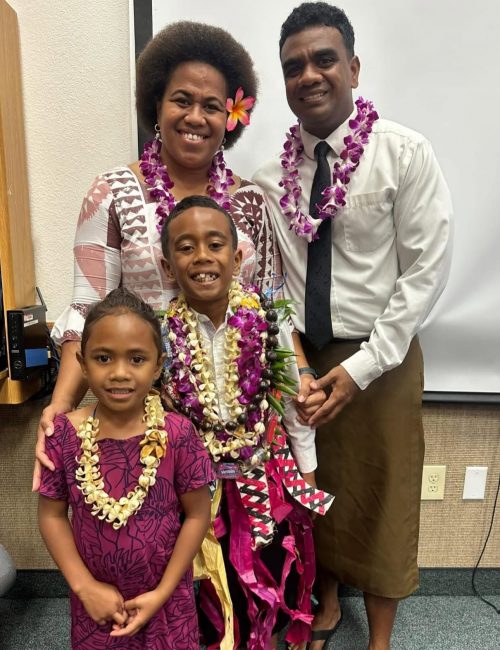
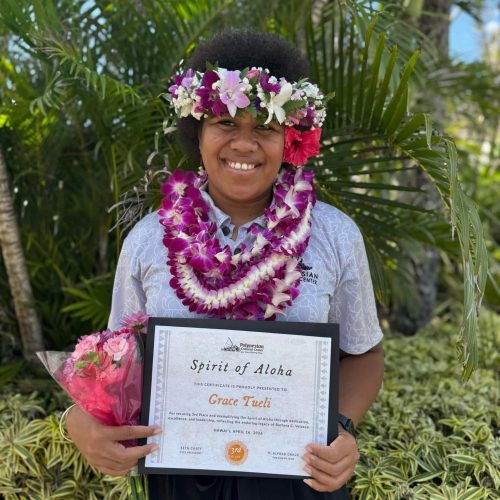
Grace Tueli is joy personified—someone for whom it might seem happiness has always come easily. A former Miss Bula beauty queen back home in Fiji, she is a recent Honors graduate of Brigham Young University–Hawaii and a recipient of the Spirit of Aloha Award from the Polynesian Cultural Center (PCC). With her contagious smile and warm presence, Grace leaves a lasting impression wherever she goes. Today, her laughter is a familiar comfort to those fortunate enough to know her—whether among family and friends, classmates at Brigham Young University–Hawaii, or coworkers at the PCC, where she is the project manager of the Legacy team. Beyond her professional accomplishments, Grace is a devoted wife to Iosefa (Joe) Taliu and a loving mother to their two children, Kenneth (8) and Esther (5).

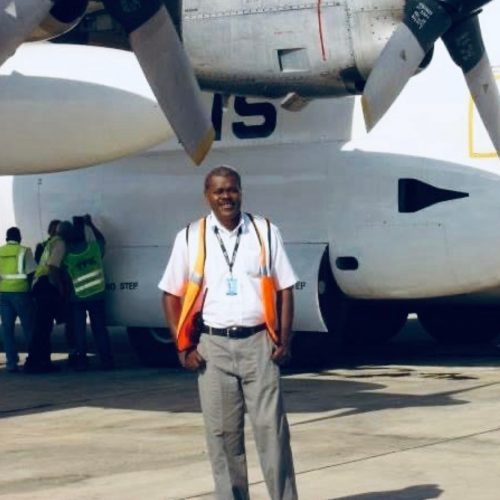
But her story is not one of ease. It is one of quiet strength, sacrifice, difficult choices, and a faith that was just beginning—but has ultimately become the foundation of her life. She grew up in Nadi, Fiji, often called “Jet Set Town”: “It’s called that because Fiji’s international airport is located in our town. The community depends heavily on tourism and aviation, so those industries are a big part of everyday life. I grew up in a place where people were often pilots, air traffic controllers, weather station workers, or employed at the airport in some way.” Her father, Inia Tueli, settled there as a young man and became one of the first air traffic controllers in Fiji, later training many of the current managers employed there.

As a 22-year-old, hoping to study medicine, but that path closed. He heard a radio announcement about an opening in air traffic control. He traveled seven or eight hours from his home to Nadi, and knocked on a stranger’s door and asked for a place to sleep: “The house belonged to a palagi—an expat living in Nadi at the time. Back then, the airport was still being developed, and there were many expatriates in the area. They welcomed him in without hesitation and offered him a place to sleep. ‘You have a bed here,’ they said. He went to the interview the next day—and got the job.” Through determination, resilience, and faith, he built a career that would eventually allow his children opportunities he never had. “Childhood-wise, academics were the center of our home. It was homework first. Wake up in the morning, go outside, do some chores—and we were just a two-minute walk from school. Our community was close; all the parents were working together. I can say I had a good childhood.”Her parents tried to expose their children to different things. Her dad put them in clubs and arranged extra tutorials for school: “I remember participating in many activities. He kept putting us in different things to see what we might be interested in pursuing. At the time, I didn’t know what he was doing. I just said yes and showed up. But now, as a parent, I can see what he was trying to do.” From him, Grace learned perseverance. From her mother, she learned something equally powerful: sacrifice. The second eldest of nine siblings, Mereseini Waqakibau left school to go to Suva to work and support her siblings’ education. She carried responsibility early, giving up her own opportunities so others could have theirs:

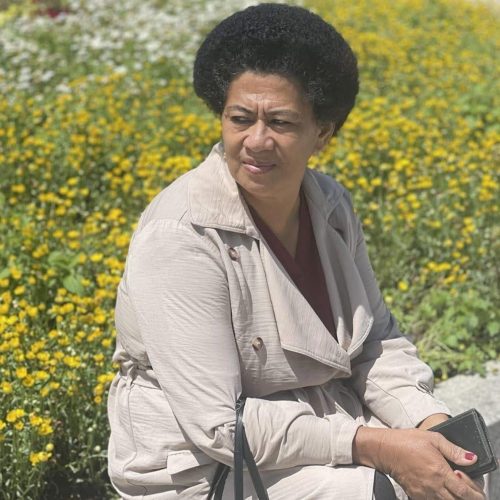
“My mum only reached what you might call high school—around age 15, which in Fiji is Form 4. She’s the second oldest of nine siblings, oldest of her 6 younger sisters, so she had to leave her island and come to the city to work, helping her parents with financing her siblings education. All of her siblings credit her for being able to complete their education because of her sacrifice.” In this home—built on grit and selflessness—education was not optional. It was expected. Grace rose to meet those expectations. With two of her sisters, she attended the elite Adi Cakobau School (ACS), most famous for preparing future government and political leaders. Located in Sawani, Naitasiri, about five hours from their home in Nadi, ACS blends indigenous culture with the skills needed to address global challenges and lead the nation. After graduation, she enrolled in the Airports Fiji Limited Aviation Academy and completed the rigorous courts to become an air traffic controller as a way of honoring her deceased father: “For me, following my dad’s footsteps… that was closure.” She was baptized a member of The Church of Jesus Christ of Latter-day Saints on October 31, 2015. She later met and married Joe, who had also followed the same career path. Alongside her husband, she built a good life grounded in hard work and shared responsibility. At the same time, Grace was expecting her second child. The demands of air traffic control—long hours, graveyard shifts, and an unforgiving schedule—collided with the needs of her growing family. What had once felt stable no longer aligned with the life they wanted:
“Air traffic control can be a demanding career, especially for families navigating shift work. In our case, our family schedule revolved around our work schedule, and it wasn’t ideal for the season of life we were in. While heavily pregnant, I decided to resign so I could stay home with my baby.”
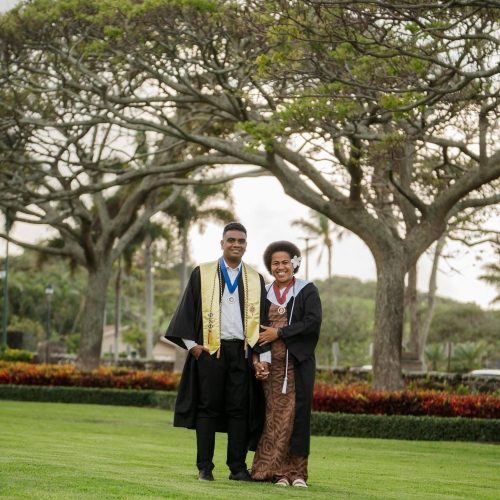
Grace registered for classes at the nearby University of the South Pacific studying Information Systems. They dipped into savings to pay tuition while balancing life on one income. Then in 2020, the pandemic began to unravel that fragile stability. When COVID-19 swept across the globe, flights stopped, airspace closed, and the industry they depended on became uncertain: “Our airspace closed—that’s when it really hit us. Our diploma couldn’t take us anywhere outside of a control tower. That’s when we realized… we needed a different path, we needed more education..” At the same time, there was a quieter realization forming: “We always paid our tithing,” Grace later reflected, “but we weren’t really active. We mostly went to church just to pay tithing.” Even so, others saw something in them. Their bishop and leaders continued reaching out. They were all alumni of BYU-Hawaii. One day, that bishop shared a strong impression: Grace and Joe should apply to study in Hawaii where their tuition would be covered ithrough the IWork program. They could go home debt free in four years; “What’s IWork?! We talked it through, did the math and realized it was a huge win for us. It didn’t fully make sense. Leaving home and family would be difficult.” But they chose to trust. That decision became a turning point.Grace, Iosefa, and their young children moved to Brigham Young University–Hawaii. Life in student housing was simpler and more uncertain—but also more intentional. For the first time, Grace could be more present with her children. Over time, faith—once peripheral—became central. “At the time, I didn’t understand,” she said. “Now it all makes sense.” She now sees the missionaries, the Relief Society sisters, and the persistent invitations differently—as acts of care and love. She has continued to frequently reach out to her former Fijian bishop to thank him for his encouragement and inspiration that has changed and blessed their lives. Grace and Joe both graduated with honors. They are still the same couple who once built a life in Fiji—but now a transformed family.

Grace carries forward her father’s resilience and her mother’s sacrifice while creating something new: a home centered on faith, presence, and intentional living. When she arrived, she faced deep personal challenges: “I wasn’t in control of my anger—it was a serious issue. It disrupted the peace in my home, affected how I treated my kids, and shaped the way I handled conflict with my husband.” Her story became one of learning to live differently—on purpose.Looking back: “When I look back now, I feel sick with regret.” At the time, she believed her reactions were normal—until one moment changed everything. During an argument, her son Kenneth hid under the table. “That image stopped everything.”She saw herself in him. A memory resurfaced. “I had heard the word ‘trauma’ before, but I never thought it applied to me. Suddenly, I could see it clearly.” Patterns once normalized became visible:
“This is how conflict was handled around me growing up.”
That awareness didn’t fix things overnight, but it gave her a place to begin. She sought counseling. At first, even simple advice felt frustrating.
“I came here for real help, and you’re telling me to breathe?” But over time, small practices led to deeper change. She learned awareness, reflection, and intentional response. As she changed, she saw her children differently. Her son’s behavior reflected the environment he had learned. “That was a mirror for me—it showed me exactly where I needed to change.” Gradually, things shifted: “There’s more peace in our home.“I don’t fight the way I used to.” Now, it’s about how she shows up—more present, more aware, more intentional. Faith became part of daily living—choosing patience, allowing space, trying again. “I truly believe that being here, and the mission of the school, played a big role in that change. It feels like a personal conversion.” Now, her home reflects something once distant—not perfection, but peace. Her journey wasn’t one dramatic moment, but many quiet decisions—to trust, to change, to believe. And through those decisions, she found peace. Looking back, she recognizes how others saw potential in her family before they could see it themselves. More than the impressive university degrees, it is faith and a better way forward that transformed their lives. Her life reflects that truth—not because it was easy, but because she chose, again and again, to change. Sometimes the hardest experiences become the very things that shape our strength. We are not fixed.We are not limited by our past.We can change.We can grow.We can become something more. “And the key message to me is a great reminder of God’s tender love and mercy—that He sees my heart. He knows my heart. And with His help change is possible.”

Facebook
Twitter
LinkedIn
No comments yet.