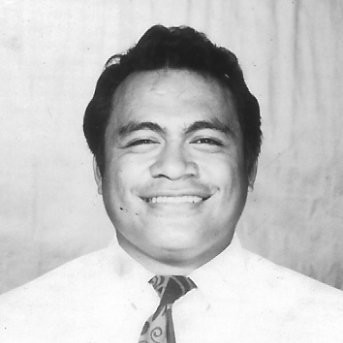
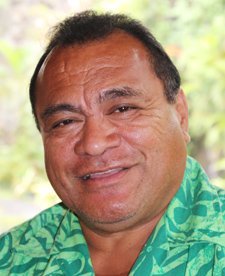
Matuauto Steve Lāʻulu, who has served as Island Manager at the Polynesian Cultural Center for the past 13 years, fondly recalls his time as a student employee at the Center. He was also one of the featured student employees in The Aloha Experiment, a 25-minute documentary film produced for the PCC by Bonneville Productions in 1978.
Shot on 16-millimeter film, it highlighted the Center’s commitment to preserving Pacific Island cultures while offering viewers a tour of its 42-acre campus. Lā‘ulu remembers seeing the finished production for the first time:
“I forgot about the camera and just did what I was asked to do each time the crew was present. I basically kind of… turned it off and couldn’t care less. When I first saw the film after it came out, I was like, ‘Oh my gosh, I didn’t even know.’”
Reflecting on the early film’s more limited scope, Lāʻulu draws a thoughtful comparison to the feature-length documentary Sharing Aloha, the 95-minute, award-winning film released in early 2025 and now streaming on Amazon Prime:
“I love Sharing Aloha. I think it’s really well done. It does a great job of showing the environment those students are in—not just at BYU–Hawaiʻi, but especially here at the Polynesian Cultural Center—and how the opportunities at PCC help them pursue their education by supporting tuition costs and making university attendance possible.”
Despite being separated by nearly five decades, The Aloha Experiment (1978) and Sharing Aloha (2025) both underscore the importance of preserving and honoring Pacific Island cultures.
The Aloha Experiment emphasized cultural preservation through the perspectives of student performers and functioned largely as an introductory tour of the Center. Its warm, welcoming tone successfully achieved that goal, Lāʻulu believes, by offering viewers an accessible introduction to the people, traditions, and purpose behind the PCC.
Years ago, the PCC was often referred to as “an Aloha Experiment,” but Lāʻulu saw it differently—not as some grand social or cultural experiment:
“I was just delving into something that I thought was fun and that was enjoyable. I had a job performing and teaching about my culture—it wasn’t that hard, and it was fun at the same time. I looked forward to coming to work and connecting with all the guests, and I was able to practice my English with them, too.”
Sharing Aloha expands that message for a global audience, highlighting cultural continuity, community impact, and the Center’s relevance in a modern context while also addressing criticisms of its purpose and practices. It offers an intimate backstage look into the lives of the students and their commitment to excellence as they overcome personal challenges to shine and perform at the PCC while being far away from their island homes:
“The Polynesian Cultural Center is a great place—not only for culture and values, but especially for helping students from the Pacific Islands to change their lives. We’re celebrating our culture and letting other people know, ‘This is our culture. This is what’s important to us.’ It’s like a living museum. We want to put it on the stage so you can see what we’re all about.”
Lāʻulu first came to Oʻahu from Samoa to pursue a degree at BYU–Hawaiʻi. He got a job as a painter on campus. After leaving Lāʻie to serve a mission back in Samoa, he returned to the university in 1977 and worked in a restaurant, cleaning the facility after closing time.
Later, he applied and was accepted to work in the Samoan Village, where he danced, demonstrated cultural practices and served as a guide. His duties also included participating in the canoe show. Another bonus of the job was the pleasure of meeting interesting people from many countries. It was an opportunity to learn about the wider world, lessons that have increased his understanding and appreciation for other cultures.
However, physical labor was something he learned and was expected to do back home in Samoa. Every morning began with chores—not simple tasks like taking out the rubbish, but gathering and preparing food. Before school, he would go to the plantation to harvest taro, coconuts, and other crops, carrying baskets of food back home. There were no supermarkets. After school, the work continued, including preparing meals for the family.
Life was hard, but Lāʻulu remembers his parents with gratitude. There were only four people in the household—his parents, his sister, and himself—so everyone worked hard because there was no one else to rely on. His parents did much of the work, but the children were expected to contribute.
Today, Steve feels that the expectations contributing to the welfare of the family at home is not as critical as in the past. He thinks students have it much easier in their island homes. It has all come full circle for him as he watches over the young people coming and going at the PCC. He strongly disputes the idea that the Center exploits culture or students:
“We’re not exploiting any culture—or the students. In fact, without the PCC, where would all these children of our Heavenly Father go for an education? I was accepted at Rick’s College (now BYU–Idaho), but how would I have done that? There would have been no support system. Here, there is a powerful support system. We are focusing on Pacific Islander students so they have an opportunity for an education. I am a product of something so great that, by sharing my culture, I am able to be compensated financially for sharing that knowledge. I don’t see how that could be a bad thing. Because we’re preserving it—that’s the other part, right?”
Lāʻulu focuses on helping students understand the importance of who they are, why they are here, and what the PCC is doing for them. He emphasizes the three C’s in every interaction with them: commitment, consistency, and remaining constant. His hope is that students will carry this legacy with them wherever they go after graduation.
“Our mission is to spread aloha throughout the world, and I love that,” he said. “That is exactly what we want to do—not only with our students, but with all employees—to ensure that this legacy reaches the world.”

No comments yet.