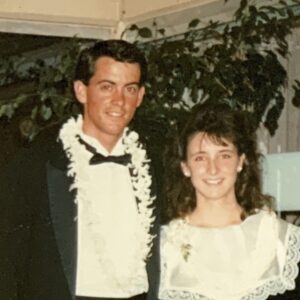
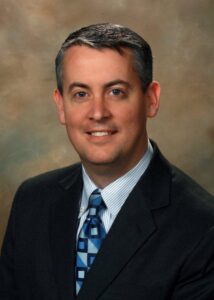
When Eric Workman, former Executive Vice President and Chief Marketing Officer of the Polynesian Cultural Center (PCC), came to Lā‘ie after serving a Church mission in Kirtland, Ohio, he was ready to begin studies at Brigham Young University–Hawai‘i. What he didn’t expect was that his life would be eternally impacted on his very first day back on the island of O‘ahu—just as it had been when he was an infant: “My dad was in the Navy and lived on the other side of the island,” Eric explains. “But I was actually adopted and sealed to my parents—my adoptive parents—here in the Lā‘ie Temple. After leaving O‘ahu as a small child, I moved more than every year of my childhood.” Rather than returning to the last place his family had lived in California before his mission—where a promising job opportunity awaited him—Eric chose instead to move once again to join his mother and sister in Lā‘ie, where his mother was pursuing further education. That choice, combined with a chance encounter at the Polynesian Cultural Center with the “shave-ice girl” of his dreams, became what Eric calls the best decision he ever made. “I returned here to Lā‘ie following my mission. That first day, my sister brought me over to the PCC Marketplace where she worked and introduced me to one of her friends, Anne Chase, who was working at Yoshimura Shave Ice. I met her, but she was still in high school at the time, so we didn’t see each other for another year.” Their paths crossed again at the Aloha Center on the BYU–Hawai‘i campus when he saw Anne from a distance but went to his office without greeting her. He couldn’t get her out of his mind and finally gave in to the promptings to go say hello to her—and this time, the timing was right: “From that day on, we saw each other almost every day. We got married not long after. I was definitely very lucky to be able to marry her.”

It’s widely known—and published for the world to see—that Eric is devoted to his wife and proudly serves to this day as President of The Anne Workman Fan Club. Several years after their marriage, Eric—then just a year away from graduation—felt prompted to seek a position at the Center. He joined the former video sales department, eventually becoming Manager of PCC’s internal retail sales. (In those days, Host Marriott operated most PCC gift shops under a concession agreement.) During part of those two years, Eric reported to Alfred Grace, who said of him: “When Eric joined PCC retail sales, he consistently demonstrated a strong work ethic and a high aptitude for business management.”

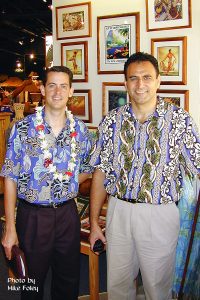
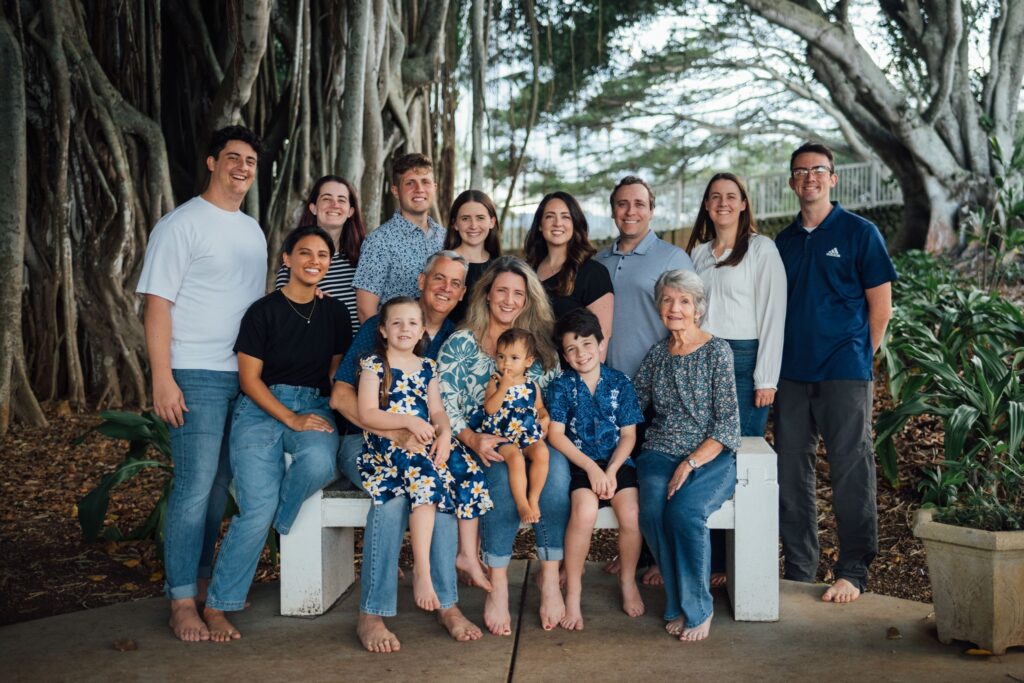
Prior to working in that capacity, Eric had been involved in student government and had served as an assistant to one of the University’s deans. After much consideration, the Workmans decided to move with their two young children to Japan for an international experience, with the ultimate goal of helping to position Eric for admission into an Ivy League graduate school: “We were a young family—it was time to go. It came down to Japan or Easter Island.” Eric had met the governor of Easter Island in Lā‘ie, who invited the Workman family to move there, where Eric would have handled marketing for the island. “But as a family, we felt Japan was the wiser choice—especially since our third child was born in a hospital there. Japan, overall, was a wonderful experience for our family.” One of his accomplishments while living in Japan was establishing The World Market, Inc., a fledgling company that eventually represented more than 100 American and European mail-order businesses. The company delivered affordable foreign goods to the Japanese public after Eric successfully negotiated with the Japanese government for more favorable tariffs on incoming products from the United States and Europe. They had been in Japan for three years when the sad news came that Anne’s father—beloved BYU–Hawai‘i English and history professor Lance D. Chase—was experiencing a cancer relapse: “We wanted to come back here and be with him for his last short time so he could get to know the grandchildren. We had another child here after we returned. And so we had three more years with him until his passing in the summer of 1999.” During those years, Eric worked as Manager of Retail Sales and Marketing at the PCC from 1997 to 2000. PCC retail sales had an exclusive agreement with Host Marriott, which—more as a favor—managed most retail operations due to their expertise and PCC’s lack of in-house experience at the time: “But PCC had retained a little piece of it—some products such as videos that were high-margin and high-volume that we didn’t let them sell exclusively. In that process, we found out that things could be done better.” The PCC team worked with Host Marriott to create a shop underneath what is now the Hawaiian Journey Theater as an example of how PCC retail could be unique—nothing like an ordinary airport gift shop: “And it worked out very well. The sales per square foot were better in our newly created space, and our cost to implement it was super low. So Marriott said, ‘Go for it.’ Dick Marriott was on our PCC Board of Directors at that time and a great friend of the PCC.” Host Marriott eventually ended its exclusive agreement, and the Center began running retail operations internally. Eric’s team set up shops at the Marketplace as well as in the island villages of Sāmoa, Tonga, and Aotearoa (New Zealand). The authentic goods—including concessions and food—enhanced the visitor experience and satisfaction. Among many other improvements, the fence around the Marketplace was removed, welcoming non-ticketed visitors and drivers along Kamehameha Highway to stop, enjoy the food, and explore the shops. The open layout resulted in increased revenue while giving visitors an opportunity to learn about the PCC—many of whom later returned for the full experience. The introduction of a mail-order catalog and online sales further expanded business opportunities. Eric’s plan to apply to Ivy League graduate schools was beginning to take shape after these career highs. After much prayer and some humbling experiences, it became clear that the BYU Marriott School of Business in Provo, Utah, was the right place for his family: “I was very grateful to go there. When I got out of BYU–Provo, I got what was one of the most sought-after marketing jobs coming out of graduate school—business development with a Fortune 50 company called the Dow Chemical Company.” The position carried significant responsibility within the company’s growth center, launching and incubating new businesses. Eric remained with Dow in Midland, Michigan, for twelve years. During that time, the Workman family grew to seven children. They built lasting friendships through the Church and community, and Eric’s work took him around the world.

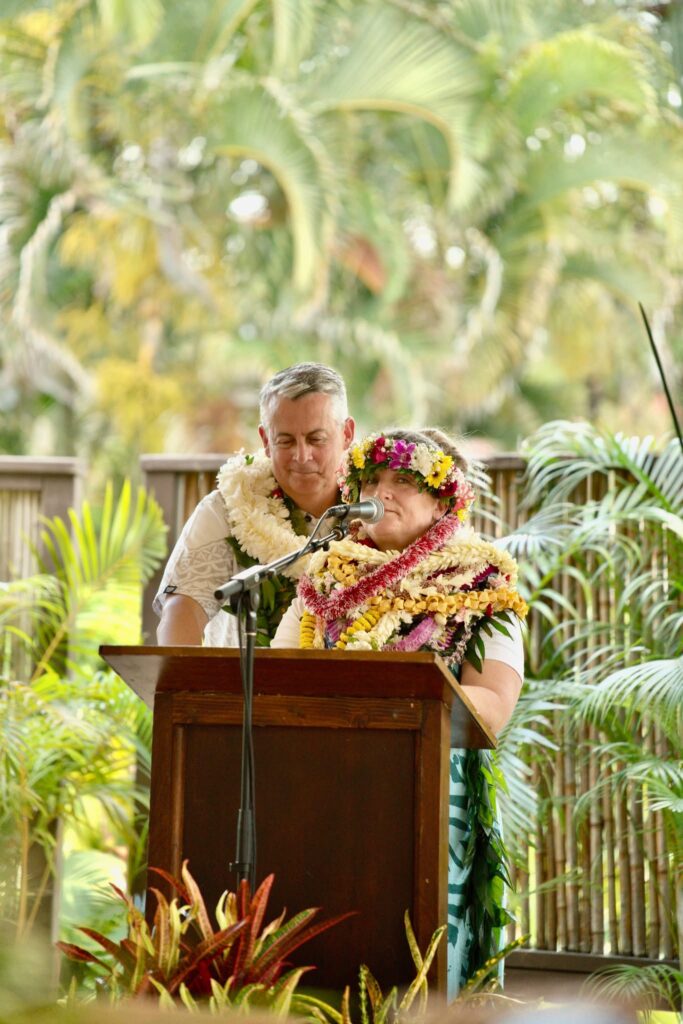
Still, Lā‘ie—and the Center—continued to call them home. He hoped that someday he might again contribute to its future success. When Von Orgill, then president of the PCC, announced his retirement to serve as a mission president, Eric felt strongly that his mentor and longtime friend, Alfred Grace, was the natural choice for CEO. Eric had previously reported to him and held deep respect for his inspired, consensus-through-counsel leadership style, which he found empowering as a management team member: “I called him up and said, ‘Hey, good luck—I bet it’s you.’ He didn’t know at that time that it would be for sure. Shortly after our conversation, he was asked to be president.” Once the formal announcement was made public, President Grace invited Eric to consider returning to the Center to help with marketing and business development. After this conversation, an interview with Fraser Bullock—President of the PCC Board of Directors—and the subsequent offer, the Workmans decided it was time to come home. President Grace said of Eric’s appointment: “After a distinguished 12-year career with Dow Chemical, Eric rejoined the PCC in 2013 as Vice President and Chief Marketing Officer. Shortly after returning, he began serving as my counselor in the Married Student Stake Presidency, reflecting his deep commitment to community and leadership.” He added: “My history with Eric dates back to 1991, when he and his wife, Anne, were residents of the married student ward where I served as bishop. It took very little time for me to recognize them as highly competent, humble individuals with an exceptional willingness to serve. Eric was subsequently called as a counselor in the bishopric, and Anne became the Relief Society president at the impressive age of just 20 or 21.” Although the couple originally expected to stay in Lā‘ie for only two or three years, their commitment ultimately extended to twelve—bringing Eric’s aggregate employment with the PCC to seventeen years. One of the most significant changes during that period was the transition from an agency-based sales model to a fully online sales system: “We started emphasizing digital sales and direct sales, and we were fortunately very successful. We went from about 15% online sales to 70% online sales. It changed the model quite a bit.” The many adjustments to a more data-driven research model—along with identifying what was truly working—resulted in a banner year in 2019, the highest revenue year in the Center’s history: “‘What gets measured gets improved.’ That’s a statement by President Monson. We live by those report cards and scorecards. The young people who work in the research and marketing areas are gaining valuable experience, and we’ve seen great success—many of them go on to secure very good jobs.” Some of these students after their internships at the PCC end up making much higher incomes than their supervisors. Eric strongly attributes the level of progress and accomplishment at the PCC to the Lord directing the work: “We often receive the inspiration we need precisely when we need it—guiding us to take actions that truly make a difference. We’ve seen this happen time and time again, along with the right people arriving at exactly the right moment. It occurs too often to be merely a coincidence” The documented success at the Center and the boom year proved providential in 2020, when the COVID-19 pandemic deeply affected people worldwide—personally, financially, socially, and spiritually. It was truly the worst of times. The reality of those challenges hit Lā‘ie and the PCC early: “PCC was the first large business in Hawaiʻi to close. Our resources on the island could easily be overwhelmed. Nobody knew back then how dangerous it was. We didn’t want to risk our students and staff.” Closing the Center and helping employees navigate the crisis became a powerful example of people uniting to support one another within the tight-knit ʻohana of PCC employees. This effort—considered a model for the State of Hawaiʻi during the closure and reopening—has been well documented in an earlier story on the PCC Legacy site (link to Mike’s story). The financial gains from the 2019 banner year—originally allocated for a new administration building—were instead used to sustain employees and maintain the property during the closure: “When COVID hit, we realized those funds were needed just to operate on our own and to stay self-sufficient. It was enough for us to get through without outside funding.” Eric reflects on what the experience taught him: “The COVID challenge was by far the worst experience the PCC ever encountered. But as a team, everybody pulled together, and everyone’s collective ideas meant that we came out of it a success. 2021 became our highest year ever—our most profitable year, with the highest guest satisfaction.” Innovation and purpose continued to define PCC leadership, including the creation of a new storytelling vehicle highlighting the students who make up roughly 80% of the workforce across nearly every department at the Center. Eric’s long-held goal to create a film became a reality with Sharing Aloha, an award-winning documentary directed by Blair Treu and now available on Prime Video. The film, which premiered in early 2025, showcases the inspiring stories of PCC student employees dedicated to celebrating and preserving their Polynesian island cultures. Eric served as one of its producers: “The movie is a beautiful effort to share our story so people get a broader perspective of the purpose behind the Center. It’s not just Hawaiʻi’s favorite visitor attraction—we exist for the students. After watching the movie, audiences will see how exemplary they are.” This project marked Eric Workman’s final major chapter at the PCC. He has since moved on to a new role as CEO of Hope Squad, Inc., based in Provo, Utah, where his goal is to expand the organization’s reach from thousands of schools in the United States to a global presence—empowering young people to support their peers during moments of vulnerability. President Grace expressed confidence in Eric’s leadership: “Through every chapter, Eric has proven himself to be an eternal optimist. This trait fuels his exceptional leadership—whether entrusting a young student with an important calling, managing complex projects, or setting strategic direction at the PCC. His business acumen is world-class and transferable across any industry. “Ultimately, Eric is a loyal friend whose character is beyond reproach. As my father always said, ‘He’s made out of good stuff.’” Reflecting on the impact of PCC students as global ambassadors of aloha, Eric shared: “We have some really wonderful, capable young people coming through here—learning good things and going out to every corner of the world. They make a difference. It makes me very hopeful and excited for the future.” As for what he will miss most, Eric answers without hesitation: “It’s the people—at the PCC and in Lāʻie. Lāʻie is a very special place, and we hate to leave. We hope to come home. We hope to return one day, and that this is not goodbye forever.”

Facebook
Twitter
LinkedIn
No comments yet.