
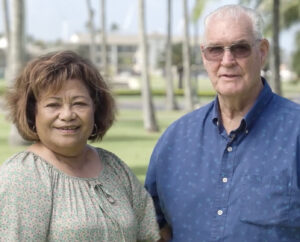
Earl Cropper, who is originally from Lakeview, a small suburb northwest of Provo on Geneva Road in Utah Valley, served as a missionary in Hawaii from 1962–64, and soon after enrolled in the Church College of Hawaii (renamed BYU–Hawaii in 1974).
A missionary on Oahu and the Big Island: As a young missionary, Earl remembers serving first in the Pearl City/Halawa area, then working his way westward toward Makaha and the small mostly-Hawaiian communities in between. Later, after a month’s “transfer“ to Waikiki, he served on the Big Island in the Honoka’a and Kamuela (Waimea) areas.
“I really enjoyed it, although it got kind of hot when we were walking,” he said, “but we didn’t have any missionaries assigned to CCH in those days.” [The author recalls, however, by the late 1960s full-time missionaries had been successfully assigned to campus.]
Earl recalls toward the end of his mission, he and other missionaries held an activity at Swanzee Beach Park in Ka’a’awa, and that day he had the opportunity to briefly visit the PCC. “Of course, the trees were all small and it wasn’t anything like now, but I remember feeling this was something I wanted to get involved with.”
CCH and early PCC days: Cropper started at CCH in September 1965 and worked on the grounds crew with Big Island student Milton Bertlemann from Waimea. The following summer, however, like many Seasiders and community members in PCC‘s earliest days, Earl got a job at the Center, starting in the Islands office [which was then located on the makai side of the Center between the Samoa and Aotearoa Villages. Frankie McFee was the office supervisor and Wayne Glaus was the general Manager. “He was a very wonderful man,” Cropper said.
Then for about a year, Earl next worked backstage as the theater manager alongside Warren Trueblood (sound and light), Shishir Kumar (tech), and others, before he transferred into the PCC grounds crew.
“We had a large truck we used to pick up all the rubbish bins and haul them to the Laie dump, which in those days was on Egg Farm Road, along with a lot of old cars. There was also an old Sāmoan guy on the crew who cut most of the lawns.”
One of the PCC student workers he got to know quite well during all of this was Anna Fa‘aumu, a young lady from Tonga who worked in the Ticket office. About seven months later, they got married.
CCH student body president: After working in student government during the tenure of Rex Frandsen, Earl was elected as the CCH student body president during the 1966-67 school year. “That was a great experience,” he said. He remembers Robin McCulloch (from New Zealand) and Marie Nin (also from New Zealand), and a guy from Europe named Petain Kampenhout “we’re among those heavily involved in planning all our activities.“
He also fondly remembers his favorite business teacher, Clyde Westwood, who was in a wheelchair his entire life. (He and his wife Kaye had “informally adopted Anna, “and we became the best of friends ever since. He died about 10 years ago,” Earl said.
The Laie years were “a wonderful time,” Earl added. “I felt very comfortable there, and I also worked very closely with Ralph Olsen, CCH Dean of Students and a former missionary in Tonga. It was a wonderful, sweet place to work and to live back then.”
The Utah years: After Anna graduated in home economics, and Earl got his CCH degree in September 1968 in business management (with a minor in religion), the young couple moved to Utah and made their lives there ever since — with frequent trips to Hawaii.
Earl had worked with his father in the family dairy farming business for years, and eventually started a roofing contracting business.
Annaʻs first job in Utah included commuting every working day to the LDS Hospital in Salt Lake City. She went on to obtain an LPN degree at Utah Valley University and also earned a registered nursing degree from BYU.
Both also continued their formal educations: Earl earned an evening-school MBA in 1990, and Anna successfully added a masterʻs in public administration degree before she retired in the early 2000s.
Asked if heʻs retired, Earl replied, “I hope so, yes,” he said, explaining he retired from his roofing business in 2012 when he and Anna served a senior health mission in San Fernando, California. “Anna was the mission nurse, and I was the helper.”
Giving back through the Matthew Cowley Society: “Education is very important in our family,” Earl continued, pointing out that their first daughter, Kalani, who had surprisingly white hair when she was born in Hawaii, led the way with a masterʻs degree. Two other daughters were born in Utah; all served missions and graduated from college.
Cropper said that he loved his experiences at the PCC years ago. “There were many wonderful students then, and the bosses were so kind. Elder Howard W. Hunter was over the PCC when I started, and he would come into the office and say ʻhiʻ to everybody.
Such experiences led the Croppers to get involved as chairpersons of the Matthew Cowley Society. “For the last 20 years, weʻve gone back to Laie at least once a year,” he said, pointing out the society consists of about 200 members “who have adjusted their wills and estates so that when they pass away, money will be donated to BYU–Hawaii and the Polynesian Cultural Center.”
“Weʻve just really loved that,” he continued. “Weʻve made contributions every year since. Theyʻre not too big, but when I pass away, a big chunk of our family trust will go to the university, enabling students to attend who otherwise could never have attended.”
“When they graduate, theyʻll go back as better parents. Theyʻll also be better Church leaders and better citizens in their communities.”
Sadly, Anna passed away in July 2025 in Utah.
To future students: Asked for his advice to students thinking of going to BYU–Hawaii, Cropper responded, “BYU–Hawaii is a great place to get an education and see how the Church works internationally. Youʻll make friends from around the world.”
“Do everything you can to qualify to go to BYU–Hawaii. Your life will be so much sweeter, and then if you can, continue your education and get a masterʻs or a doctoral degree. Get as much education as you can.”
Your comment has been submitted for administrator approval.
Your comment was not saved. Please try again.
No comments yet.