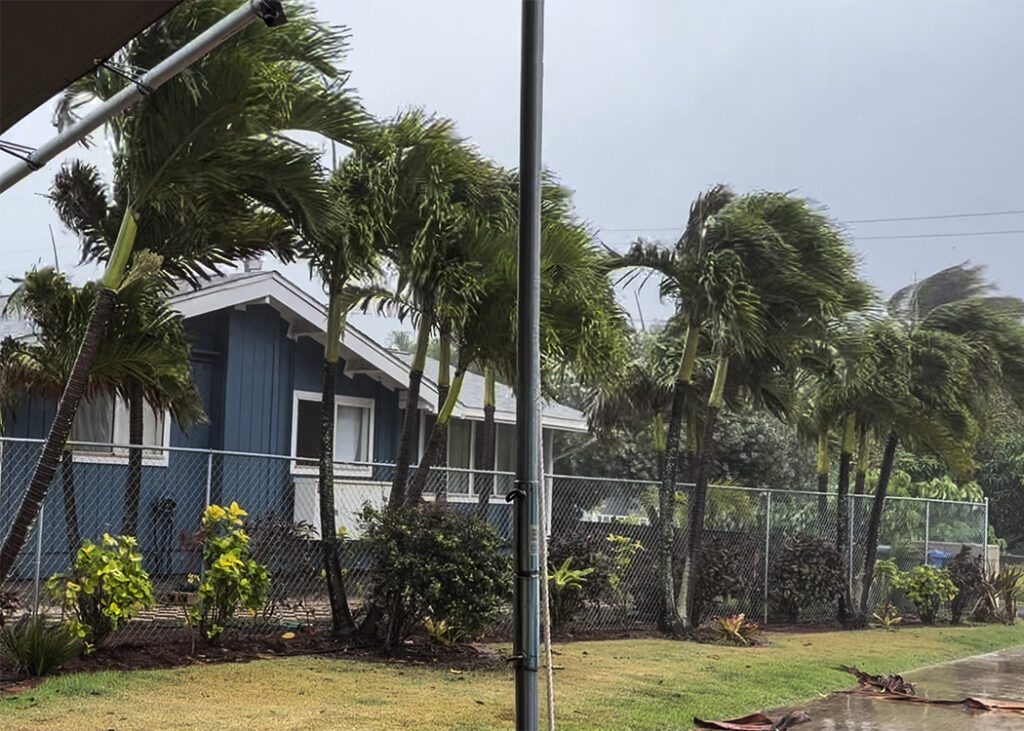
By Saturday, August 15, 2026, everyone in Hawaii was forced to pay attention to weather reports as low-grade Hurricane Lala approached from the Eastern Pacific, on track to hit the southern end of the Island of Hawaii, then continue westward somewhat south of the other islands, which it was also forecast to impact to a lesser degree.
PCC prepared in advance: June through November is normally “hurricane season” in Hawaii, and weather forecasts said Lala, carrying winds above 100 miles per hour, would sweep over the high volcanic peaks of Mauna Loa and Mauna Kea while dropping as much as 25 inches of rain on the Big Island, but were projected to do less damage to the other major islands.
Even so, the Center had prepared well in advance and closely monitored the situation. “We decided to remain open since there was no imminent threat to guests, employees, safety, or operations,” said Tagaloataoa Delsa Moe, PCC vice president of cultural presentations.
“Our Facilities and Maintenance team began to prepare in advance by delivering pallets of sandbags to vulnerable locations, dropping the level of the lagoon in anticipation of possible flooding, removing shade sails and aerial banners, and making sure they had extra diesel and gasoline supplies on hand to operate the Center’s large generator and heavy equipment.
Early-morning Sunday alerts: As early as 5 a.m. Sunday, while the southern end of the Big Island was taking a “direct hit,” State emergency media issued potential flood alerts on the other islands, and within three hours, Hurricane Lala caused the statewide electrical system to shut down for as many as 240,000 people.
“But we didn’t experience any significant damage,” said Moe. “Center maintenance staff turned on our big generator and ran it continuously through Tuesday. Of course, there was a lot of wind-blown rubbish that Sunday that needed cleaning, but otherwise we remained open on Monday and Tuesday.” (The Center normally remains closed on Wednesdays, since the end of the COVID-19 pandemic.)
“We also released any employees who felt they needed to stay at home those days to take care of their families.”
Keali‘i Haverly, PCC vice president of physical facilities, cultural theming, and sustainability, who was off-island during the power outage on a previously scheduled trip, explained the Center’s generator located outside the mauka (“inland”) facilities and maintenance warehouse can more than meet the electrical needs for both the front and back of the house, as well as to assist the adjacent BYU–Hawaii. For example, we powered the university’s Cannon Activities Center for a portion of the three-day outage.
The maintenance team follows set protocols: “We have very strict protocols for windstorms, rain, hurricanes, and both locally and distantly-generated tsunamis,” Haverly noted. “These include using sandbags, removing things that could be destroyed in heavy winds, and removing rooftop equipment.”
“Our team performed flawlessly, above and beyond,” he said, “ensuring the generator was running throughout the entire duration, including that it was properly fueled (with diesel) and maintained with a cooling system.”
“Once power becomes consistent in the community, we still choose to stay on the generator if it’s after about 4 p.m. because even a little ‘blink’ in power loss going from generator to municipal power is too much for some of our sensitive kitchen, computer, and theater electronics. In fact, we’ll stay on the generator past the end of the night show.”
Haverly also explained the Center “couple’s our generator with very large uninterruptible power supplies (UPSs). For example, the one connected to our theater can carry the night show for 15 minutes without even turning on the generator,” he continued. “Sometimes our night show employees have no idea power has gone out until they leave the Center’s powered premises and discover the community is dark.”
“The generator also keeps food, computer servers, refrigeration, and freezers running 24/7. It’s a constant process of making sure our generator is big enough to run the entire Center. We also have three solar arrays at the PCC right now: One on the maintenance building, another on the night show theater, and one on the Hale Aloha.”
Moe also pointed out that some community members benefited from the Center’s generator. “When their power had been off for over 24 hours by Monday, they came to the Hukilau Marketplace, which is open and free to the public, where they were able to buy food, recharge smartphones and other similar devices, and use the restrooms.”
Laie’s unique electrical sewer pump system: In reference to her latter comment, Legacy content creator Mike Foley [who worked in public and community relations for Hawaii Reserves, Inc. (HRI) when the following changes were made] explained our somewhat unique and formerly private sewage system consists of underground “tanks” on each property that were subsequently turned over to the City and County of Honolulu (Board of Water Supply). Residents now pay monthly fees to the Board of Water Supply to operate and maintain them, “but those fees should not be confused with the “water bills” that the still privately owned Laie Water Company charges,” he said.
Foley pointed out the “house-end” of the system works by gravity, with content either draining or flushed into an underground tank that contains a floating electrical switch. When the tank’s contents reach a certain level, an electric switch inside automatically turns on a pump that sends the tank contents to the closest sewer “main line” buried under a nearby street, from where everything is further pumped to the treatment plant mauka of Laie.
“Fortunately, most community residents understand these individual sewer tanks stop working when the power goes off, and could possibly back up into the house (starting with the lowest drains, usually tubs) if residents keep draining water for washing, bathing, doing laundry, too much flushing toilets, etc.
“Our water system in Laie works by gravity from a million-plus-gallon tank located above the community, but it’s refreshed from an electric-pump-driven well system, so it could conceivably also stop after a very long power outage. Meanwhile, for shorter outages, the generator at the PCC keeps the septic tank system operating at Hukilau Marketplace and other drains and restrooms on the grounds.”
HECO restored most electricity in Laie by Tuesday night: Hawaiian Electric Company (HECO) utility workers (and their counterparts on other islands) restored electrical delivery systems to most residences throughout Hawaii by Tuesday night, including the sewer pumps in Laie. “Each of these includes a nearby control box that makes a loud chirping sound and blinks red lights that must be ‘manually reset by pushing a button on the bottom of the box when the power is reset,” said Foley.
“We had already gone to bed earlier than usual, since basically everything in our house had been turned off for a little over two days by then,” he continued, “when our sewer pump control box — located on the back wall of our house near our bedroom window — shocked us awake about 10:45 p.m.”
“Fortunately, our son got up and quickly reset it,” Foley said, “and like most modern Americans, we silently thanked our utility workers. Though I’ve lived in places without electricity for long periods in the past, we are simply not used to going without our electrical devices and conveniences for very long.”
[NOTE: It took longer for some remote Hawaii residents, especially on the Big Island, before electrical power was restored in their respective areas.]
Foley added, “You might want to read my related story about living without electricity in Sāmoa years ago” (under Legacyʻs Talk Story category).