
Reprinted from the January 19, 2008 Kaleo Community Newspaper, story and photo by Mike (Mikaele) Foley
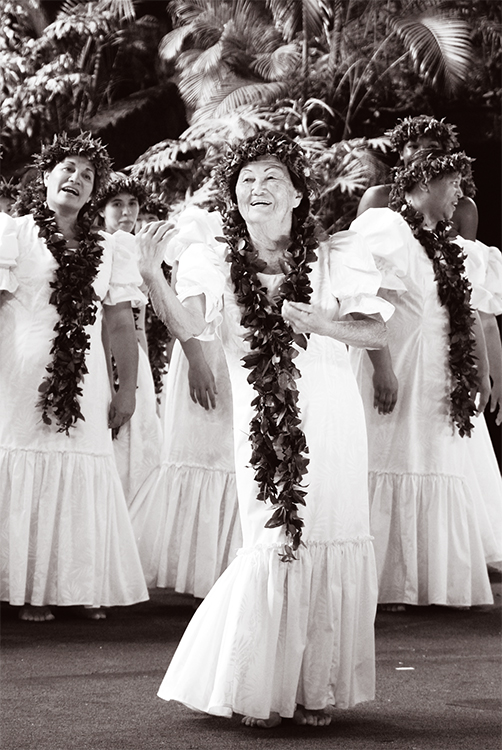
Aunty Dora Kalihi Akina was 85 and the oldest dancer participating in the Polynesian Cultural Centerʻs Moanikeala Hula Festival on January 19, 2008, as a member of Kela Millerʻs group, Hālau Hula ʻO Kekela — and she looked very good on the Pacific Theater stage.
Itʻs a family thing, of sorts: Akina was born in Honolulu, lived on the Big Island for seven years, and then moved to Laie in 1930 as a child where the Ka‘i‘o family adopted her. (Miller, one of the PCCʻs original hula dancers who also performed in the Laie Hukilau, has a unique hula “genealogy.”)
“Laie School at that time had up top sixth grade, and then you go to Kahuku,” said Akina, who has lived in Hauula since 1980. “And Kahuku at that time only had up to ninth grade.”
Akina said she worked hoe hana [field work] at the Kahuku sugar plantation, then in the pineapple cannery [in Honolulu] every summer; “and after that I got married” to the late George Akina Jr. of Laiemaloʻo [between Hauula and Laie]. The couple eventually had eight children.
She also worked at IGA [grocery store] in Hauula and at Kahuku Suprette — “for 75 cents an hour,” and retired over 20 years ago as a custodian at Hauula Elementary School.
Perhaps more amazing, Millerʻs great-grandmother, Luika Pele Kaʻiʻo, a noted kumu hula, gave Akina her first instruction in the dance soon after the girl moved to Laie. She recalled Kaʻiʻo would crack a whip when the girls giggled. “It was scary, but thatʻs discipline. We practiced outside in the yard. She didnʻt hit you. It was a warning you better listen.”
“We had about 20 students, and we used to dance for the Hukilau when we were trying to make money to build the [Lanuhuli Street Laie] chapel. When Kela started teaching about five years ago, I started dancing again,” Akina continued. “Kela’s one is modern. When I first learned from her great-grandma, it was different. You going motion, you just stay in one place. You’re shaking your hips, but in one place.”
Aunty Dora particularly remembered practicing the “break: They put you up to the wall, and your shoulders have to be straight. They claimed a good hula dancer donʻt shake the shoulders — only the hips. That’s what I learned from Kelaʻs great-grandmother.”
“Also, you donʻt have too much of that hip-rolling motion, ‘ami. She donʻt teach the ‘ami; she donʻt like the ‘ami. There was another hula instructor from Kahana: He does ‘ami all over from the beginning.” Almost eight decades later, Akina said todayʻs modern hula auana is “any old way, but I love it.”
Friend and neighbor Diane Ah Nin makes sure Aunty Dora gets to weekly practice. “Weʻre the best of friends. We hele [go out] all over; and when itʻs time for competition, or have to dance for somebody, they make it twice a week.”
An Nin, a runner for the hālau, still has all of her original implements. “Some is from my mom, who also used to dance for the hukilau.”
Asked what she likes most about hula today,” Aunty Dora quickly replied, “Getting out of the house. As long as Kelaʻs there to teach us, Iʻll try.” She admitted, however, sheʻs felt like quitting. “Iʻm too old. The audience wonders what that old lady is doing up there.”
“I like hula, but I have no Hawaiian blood. Iʻm Chinese-Japanese, but was adopted by Hawaiians. As I grew up in Laie, Kelaʻs great-grandmother recruited me to dance. You donʻt pay. From that time to this, itʻs free. Kelaʻs teaching it for free. When she opens up her new section for little children, then Iʻll take my great-grandchildren, too. Theyʻre about four.”
“Itʻs an honor and a privilege to have Aunty Dora dance with us, because of my great-grandmother,” Miller responded. Any kumu hula would want her in her hālau. Sheʻs an icon in my hālau.”
When Aunty Dora is not dancing, she said she goes to senior citizen activities “every day when theyʻre open,” such as participating in Ko’olauloa Hawaiian Civic Club meetings, and also helping with childrenʻs book projects in Hauula.
[UPDATE: Aunty Dora passed away at age 97 on May 22, 2020.]