
I recently watched a social media video clip filmed near Laie Bay of popular PCC Samoan cultural ambassador Kap Te‘o-Tafiti sampling a bite of loli — what Sāmoans call the sea cucumber or edible sea-slug — which prompted me to share my own memories of sampling various exotic foods when I was a young Latter-day Saint missionary in Sāmoa almost 60-ish years ago. (I hope that’s enough of a connection to justify this LEGACY > Talk Story article for you.)
Perhaps one of the things that impressed me most about Kap eating the loli — he seemed to like it.
I think the “key” to liking loli is acquired tastes: First, I must confess I do not actually remember tasting or experiencing any loli while I served as a young missionary in Sāmoa for two-and-a-half years from 1965–‘67, but after moving to Laie after my mission, I used to occasionally watch an old Sāmoan neighbor lady scour the reef off Hukilau Beach, looking for the delicacy she first ate as a girl in the South Pacific.
In fact, that’s the “key” with most figota — or how Sāmoans categorize edible mollusks, invertebrate sea animals, and similar creatures, some of which are very popular. They are acquired tastes, and there are lots of them in Hawaii and Sāmoa. In order of my personal encounters, here are a few delicacies, and I confess in advance, I didn’t like most of them.
Pe‘a — “flying fox” bats: In my very first missionary area centered on Faleniu, American Samoa, where practically everything about Samoan culture was new to me, a very kind lady offered to have her cousin shoot some pe‘a or “flying fox” bats for my companion and me to eat.
If you ever saw the 1984 movie, Indiana Jones and the Temple of Doom, you have a good idea of how large flying fox bats can be in Sāmoa and Tonga. In Sāmoa, they are considered “open game” and a delicacy; in Tonga, especially the village of Kolovai, they are tapu and only royalty are allowed to eat them.
We politely declined the respectful offer, according to Sāmoan tradition, but I have since learned there is very little meat on the flying mammals, so I donʻt feel like I missed much.
Supo sega — parakeet soup: As little meat as a pe‘a has, my next delicacy experience had even less. A few months later, still in the early days of my mission, my companion and I were assigned to the village of Fiti‘uta on the remote island of Ta‘ū, Manu’a, American Sāmoa, where one of the old respected chiefs defied local tradition by inviting us to lunch one day.
Almost all the chiefs there belonged to the predominant Protestant church, and while they would occasionally talk with us, they would not invite us to eat with them. This man, however, had a grandson from California who was also serving a Latter-day Saint mission at another place in Sāmoa at the same time as us, and in that spirit he treated us graciously and even prepared a special dish for us: supo sega — parakeet soup.
Surprisingly, the soup was bright green in color, with two tiny plucked and boiled parakeets floating in it. Like many fowls, the miniscule amount of meat tasted a little like chicken. The most important thing was the invitation honored usas Latter-day Saint missionaries.
A song-prayer, and fua laumei in Olosega — turtle eggs: During my six months in Manu‘a, I also spent several weeks living on Olosega, the middle of the three small islands there, where another local family who belonged to the predominant church hosted us (I’m somewhat saddened to say I’ve forgotten their names). I had two unusual experiences with them:
For the former, as we did each evening, we joined the family in a prayer circle before dinner, where the father told his children to pray. I respectfully closed my eyes, only to be surprised when they started to sing. Afterward, my companion told me that was the prayer, and this custom was common in Sāmoa.
I also since learned the same is true in Hawaii when I accompanied my twin daughters to several meals at Kamehameha Kapālama, where they went to school and everybody sings the Queen’s Doxology as the prayer before meals, but that long-ago night on Olosega was the first time I ever heard it.
I was also introduced to turtle eggs there for the first and only time, which the family was quite proud to do. I’ve forgotten how many each my companion and I were served, but I remember the eggs were about the size of ping-pong balls and grayish in color when cooked. Presumably they had been boiled.
I picked one up with my hand (Sāmoans traditionally eat with their hands) and attempted to bite into an egg, only to be surprised it was leathery and I couldn’t bite into it. I whispered to my companion, how do you eat these?
He whispered back, “Try to cut it a little with a knife,” which I did. Then, putting the opening to my mouth, I nearly gagged because in my lack of experience, I found turtle eggs were unpleasantly fishy-tasting.
Everyone was watching me as I barely managed to choke that first one down, and I think the only thing that kept me from embarrassing myself more was that I was still considered an inexperienced missionary at that point.
Sea (“SAY-uh,” not the synonym for “ocean”) a Sāmoan delicacy?: Months later, after experiencing a full-blown hurricane in early 1966 while still living in Manu’a, I was transferred to the Western Sāmoa island of Upolu and assigned to serve in the villages surrounding Tuana‘i. By then, I had lived in Sāmoa for about a year and was relatively fluent in Fa‘aSāmoa, what Sāmoans call their own language and culture.
During that time various other missionaries had warned me that fun-loving Sāmoans often tried to get pālagi (i.e., Caucasian) missionaries to sample sea — a slimy seafood some people describe as the guts of sea slugs, but I also think it looks like lobster guts, based on my experience of watching Hawaiian classmates when I was in college break off an “antenna” and use it to ream out a lobster, then drag out the guts which looked just like sea to me.
Whatever its source, Sāmoans would collect sea in old soda bottles filled with salt water, corked with a hand-carved piece of coconut husk, and sold in practically every little market in Samoa. It didn’t look very appetizing to me.
Anyhow, one night in Tuana’i when a family offered it to me during dinner, I figured I better get the experience over with when they offered me some. Missionary friends had advised me over the months that it was best just to swallow everything without chewing, but about the moment a long icky strand got stuck halfway down my throat, my gag reflex kicked in, and I chomped down trying to move it along:
Like TV food personality Andrew Zimmern, who was famous for his “iron-bound stomach” and ability to eat just about anything, sea was one of the few foods he couldn’t handle. In fact, if I remember correctly, he described it as “poopy,” and for me, the only thing close to how disgusting it tasted to my unaccustomed palate was the turtle eggs I had eaten about a year earlier in Manuʻa. Are new missionaries still being tested on whether they can swallow sea?
Spiny sea urchins, sometimes called tuitui (“sharp, pointy”) or vana (which is also pronounced exactly the same but written wana in Hawaiian): In early 1967, I was assigned as the district missionary leader for the west side of Savai‘i island (and lived in Sāmata). One day while out tracting, my companion and I came across a large Sāmoan woman sitting on the cement steps of a small village store in our area. She was rubbing what appeared to be a wet burlap bag of rocks back-and-forth on the cement.
“What are you doing?” I asked in polite Fa‘aSāmoa, never having seen anything like that before. Opening the bag, she explained she was getting ready to eat vana —spiny sea urchins (which are related to sea stars and sand dollars), and that rubbing the bag back and forth knocked off their sharp spines, which could sometimes embed themselves in a person’s skin. Looking inside the bag, I saw she had basically knocked off all their needle-like spines, and I could see spine sockets still rotating like little alien eyes. The vana were still alive, in other words.
In typical Sāmoan custom, she respectfully offered us the first choice. I politely declined, after which she picked one out of the bag and, holding it like an egg, cracked it against the cement. With some of its “juices” dripping out, she quickly brought the whole thing to her mouth and loudly slurped out all the contents. I must admit, I found this a little shocking, and thought that experience pretty much “closed the door” on any desire I had to sample vana. In fact, it kind of gave me the creeps.
A follow-up wana experience: However, about a year later in Hawaii, a friend offered me the yellowish parts of fresh-caught wana floating in a small bowl of soy sauce with small Hawaiian and Sāmoan red peppers and slices of onion. Unlike the lady in Savai‘i, my friend explained to me that their family only ate the roe, or reproductive parts; and fearing the worst, I actually tried some again.
It wasn’t too bad the second time around, but I’ve never gone out of my way to try it again. Indeed, it reminds me of a Hawaiian delicacy that used to top local luau menus: ‘Opihi are small snail-like limpets that stick themselves so well to the tidal zone of seashore rocks that they must be pried off. This can be dangerous in rough water, and I don’t remember the last time I saw any served at a Hawaiian luau.
The Halloween full-moon signals the coral bristle worm harvest: Every year in the tropical West and South Pacific Islands during the full moon about Halloween time in the US, bristle worms — called palolo in Sāmoa — detach their rear, reproductive parts which rise from the coral reefs to mate on the surface in the moonlight (while the rest of the worms, which are capable of regenerating those parts, remain below).
Though I’m no longer aware of how popular this annual event is, in years past their harvest could also turn into a frenzy as people waded offshore in the moonlight to scoop up the creatures with nets, buckets and other containers. Some were eaten raw right there, while others were saved and cooked in various ways.
I returned to American Sāmoa a few years later to visit friends who offered me some of their “catch” they had fried in butter and frozen. I had never eaten palolo before and was a little anxious about whether I would like coral sea worms but, I thought, at least it wasnʻt raw palolo.
Sorry, while I appreciate a lot of people have acquired the taste and look forward to engaging in the annual palolo “run,” I guess I’m just not a “very good Sāmoan,” because I didn’t like it at all, and I do not plan to ever accept any, if offered to me again.
Ending on a positive note: When I was a Church College of Hawaii student (in the late 1960s), I belonged to the extracurricular turtle club, mainly because I wanted to learn how to scuba dive (which I eventually did). Most of the other members would snorkel, spear fish, barbecue fresh catch right on the beach, and have a good time. The fish didn’t get any fresher.
However, there were a couple of Tongan members, including handsome Harry Wight whom I knew from the Polynesian Cultural Center night show, who were excellent free divers with at least five minutes “bottom time” (i.e., they didn’t use special equipment and could hold their breath that long before surfacing). They sometimes caught green sea turtles for the club — which was legal to do in those days — and we also barbecued them in their shells.
If you’ve never eaten green sea turtles somewhere they’re legal, it turns out they have delicious white meat that, yes, tastes a little like chicken!
And finally, if anyone feels I had too weak a stomach or a temperamental appetite as a young man, I confess I was a particularly picky eater as a child, but I had made a lot of progress by the time I got to Sāmoa. Heck, I remember some of my pālagi counterparts there had never eaten white rice before, and didn’t even like Sāmoan koko-rice or kōpai. I mean, come on; and I don’t remember those bottles of sea selling very quickly years ago. At the same time, please don’t tell any of my ‘ohana I would much rather eat Sāmoan fa’alifu-style taro than Hawaiian-style poi.
Which of the above delicacies would you like to try for the first time?
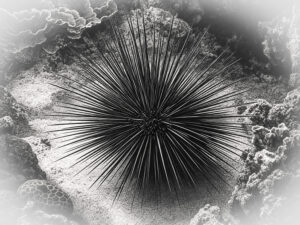
A large, spiny vana near the beach. I remember a friend of mine got her foot pierced when she inadvertently stepped on one.