
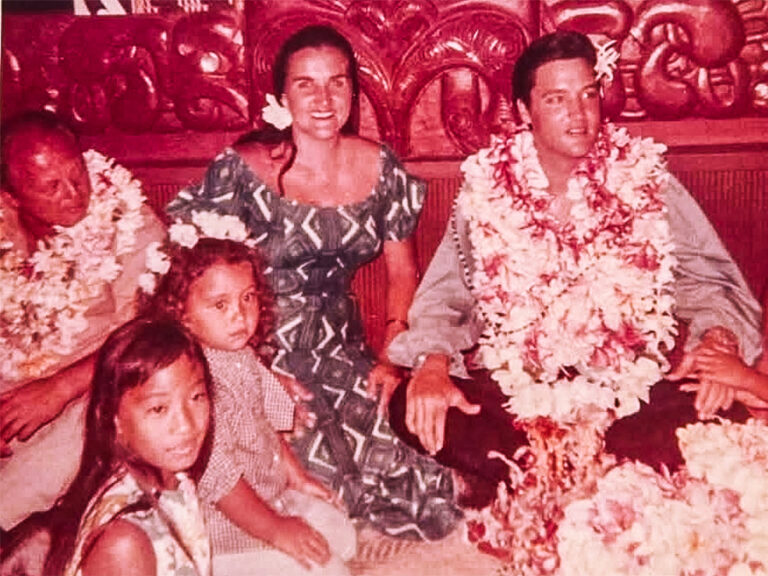
…who first performed with the popular Polynesian Panorama group in Waikiki before becoming one of the original dancers at the Polynesian Cultural Center when it opened in October 1963.
But first, some regional history: Polynesian performing groups have always been popular. For example, Hawaiian Latter-day Saints who migrated to the Iosepa settlement in Skull Valley, Utah, formed the Iosepa Troubadours in the late 1880s and made numerous appearances throughout the region that were immensely popular.
Back home in Hawaii in the early 1900s, island entertainers started touring all over the world, and several commercial predecessors to the Polynesian Cultural Center — such as Lalani and Ulu Mau Village, the latter actually overlapping the Centerʻs early years — started up on Oahu with varying degrees of success.
When conditions settled down after World War II, members of the Laie Ward started the Hukilau in 1948 — which featured demonstrations, guests participating in the hukilau fishing event, a luau, and entertainment on Hukilau Beach — initially as a way to raise help funds to rebuild the old I Hemolele chapel (which accidentally burned down in 1940). It continued until 1971.
Soon after the Church College of Hawaii started in 1955, Hawaiian and other island students under the direction of original faculty member Brother Wiley Swapp, formed a club that learned and performed Polynesian songs and dances. As their skills grew, the club evolved into Polynesian Panorama, a polished troupe that made regular small-group appearances in Waikiki and also put on at least two major sold-out productions in those early years before the PCC.
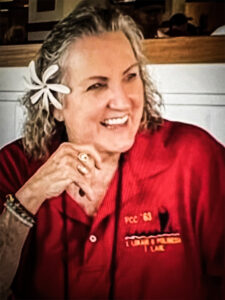
Lokelani Lindsey, 88 at the time of this interview, was a young Hawaiian woman from Hauula who had two children, when she became a member of that group. She recalled many of the Panorama performers also became original employees and dancers at the Polynesian Cultural Center.
Lokelani shared some of her memories of what soon transpired:
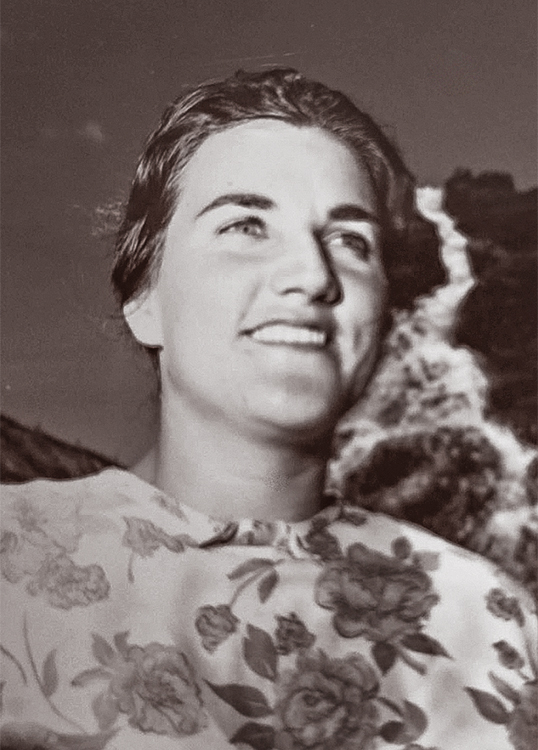
Lokelaniʻs back-story and family ties: She was born Marian Maples in the old Tripler Hospital (then located “just off Middle Street in Honolulu”), and lived her earliest years with her mother and father in her grandmaʻs home on 10th Avenue in Kaimukī.
“My grandfather was actually from Ireland, but after his family emigrated to the United States, he stowed away on a whaling ship out of Rhode Island and ended up on Maui,” she said. “He used to tell us there were so many whaling ships (moored side-by-side) in those days that he could walk across the harbor on their decks.”
Her “Grandmother Leslie had her own fish store in Chinatown, and when her grandfather passed away, she married Captain Lucky Davenport, who brought the first refrigeration to Hawaii on his boat so they could transport fresh fish from Kona to Grandmaʻs fish market.”
Lokelani explained Grandpa Davenport adopted most of the Leslie children, “but not my mother, because they said sheʻs going to get married and change her name anyway.” Old-timers at PCC may recognize the Davenport name from Audrey Davenport, another original dancer, who married Earl Veloria and eventually moved to Kona. “Thatʻs my real cousin,” Lokelani said. “My mother and Audreyʻs father are brother and sister.”
Early schooling and World War II days: After an unsuccessful marriage to a Hawaiian woman from Waikapu, Maui, Grandpa Davenport “married my grandmother and built our house in Kaimukī.” During those war years, Lokelani remembers “watching the Japanese planes fly over after they bombed Pearl Harbor. All I can remember was the whirring-sounds of the engines, and the great big red-suns on the wings of the planes. My grandma and I were at Punaluu, where she had a beach house.”
“We had blackouts, food rationing, and curfews when we werenʻt supposed to go out after eight oʻclock at night. We couldnʻt get sugar, so my uncles used to collect honey up in the mountains, and we also had lots of fish from the ocean.”
“All the car lights had crescent-shaped blackout masks they used after dark. There were search lights all over the skies, looking for Japanese planes. We used to watch them from our bedroom window.”
“If the air-raid sirens went off when we were in school,” Lokelani said, “we had to climb underneath our desks and put on these horrible gas masks. It was a whole different time for a young child to grow up.”
“We also couldnʻt swim in the ocean, because Japanese mini-subs might come in, and all the beaches had barbed-wire strung along them. All fishermen had to have a number on their boats, and if they didnʻt, US soldiers could shoot the boat out of the water, which happened to a fisherman at Kahana Bay.”
A short-stay in Seattle and moving to Hauula: Because her father thought they might get bombed during World War II, “we sailed zig-zag all the way on the Matsonia to Seattle, Washington, where my fatherʻs parents lived. I went to elementary school there for two-and-a-half years, but my mother got sick and tired of the rain and cold.”
When Lokelani was seven years old after WWII, her family returned to Hawaii and Lokelani ended up attending Aliiolani Elementary School. She explained that because her father worked at Mokapu (in Kailua), he had “to drive over the new Pali Highway every day, so he decided we were going to move to the Windward side…into a house in Hauula” (near the present-day shopping center).
“I started school at Kahuku Intermediate & High School as a seventh grader,” Lokelani said, “and continued there until I quit in the 11th grade” when she got married at age 16. She added her dad felt women didnʻt have to go to school.
Her first marriage: When Lokelani first got married to a man named Donner, her husband had been in the US Marine Corps, but “decided to get out and go to work in Kentucky, where his oldest sister lived. Her name was Loke, and she was from Hauula. After a while in Kentucky, my husband reenlisted in the Marines, was transferred to Quantico, Virginia, and eventually deployed to the Middle East on a confidential assignment, “so I ended up coming back to Hawaii in approximately 1965,” she said.
“Two other ladies and I eventually petitioned the [Territorial] Department of Education to let us go back to the public school, because there was no adult education out here, and we wanted to graduate from Kahuku.” The DOE granted their petition, and Lokelani is a true RR4L graduate, Class of 1956.
Joining the Church, getting remarried, and enrolling at CCH: In addition to finishing high school during those Hauula days, Lokelani said she divorced her first husband and that Latter-day Saint missionaries began visiting her in 1960.
“I was then a member of the Church of Christ, the little one right across from the current Hauula Shopping Center, and my dad wasnʻt happy when I joined the Latter-day Saint Church, but I had two little girls, and we started going to the Hauula Ward. A band teacher named Stoddard was my bishop, and I was the only member in my family who joined.”
“One day I was baby-sitting [the late] Kapua Sproatʻs son, Ka‘ohu, when she had gone back to school at CCH, and she told me, ʻYou should go to college, too.ʻ I said, I canʻt go to college, I have two kids.”
“But Kapua talked to Bishop Stoddard, and he asked me, ʻAre you interested in going to school?ʻ I said, I am. So he said, “Okay, weʻre going to start doing something so you can go.ʻ He had been my bishop when I got married to Steve Lindsey and Sister Stoddard sewed my dress for me, because I didnʻt have anything. When Steve and I got married, my uncle Dickie was in charge of the Honolulu Tabernacle, so he made all the arrangements for us to get married there.”
“By the time they got me convinced I should go to college, I had temporarily moved to Maui with my auntie, but it ended up I got my acceptance letter to CCH while I was there. I enrolled at CCH in January 1962,” Lokelani continued.
Overcoming a hurdle to join Polynesian Panorama: “After I started classes,” Lokelani continued, “I wanted to join the Polynesian Panorama group, but when I went to apply, Brother Wylie Swapp, who was in charge of it, said, ʻYou cannot come into my class. Youʻre not Polynesian. Youʻre too fair.ʻI said, I am Polynesian, but he said, ʻIʻm sorry, Iʻm not letting you in.ʻ“
Lokelani appealed to Ralph Olsen, then CCH Dean of Students, who called Brother Swapp, and said, “I have a full-blooded Polynesian in my office, and she has to go into your class per the written description in the class syllabus.” He replied, “I donʻt want her in the class,” but Dean Olsen insisted.
“Well, I will enroll her,” Brother Swapp responded, “but I have some conditions: She has to go by her Hawaiian name, Lokelani, not Marion. She also has to dye her hair black, and she has to dance in the third row.”
“Dean Olsen asked me, ʻDo you accept that?ʻ I said, Yeah, Iʻll accept that, and thatʻs how the school rolls changed my name to Lokelani Lindsey; but I didnʻt dye my hair. I sprayed a black tint on it they used to have in those days for about a month, which I could wash out; and when Brother Swapp found out I could already dance, I soon moved from the third to second row, and finally to the first row,” Lokelani recalled.
How Lokelani learned hula as a girl: “When I was a young girl, my cousins were singers, and I ended up being their dancer. My Grandma used to teach me how to dance since I was seven or eight years old. Of course, in those days, we also did a lot of dancing in school for May Day programs and things like that, and I also danced while my cousins sang every time we had family parties.”
The Polynesian Panorama: Lokelani ended up dancing in Polynesian Panorama for the whole time it existed. “When we started, we just had Hawaiian, Samoan, and Maori groups. Then, as different Polynesian students came, we learned to do Tahitian, and some of the other islanders also started learning Hawaiian,” she said.
“We didnʻt have the Polynesian Cultural Center yet, but we ended up entertaining at Heeia [near Kaneohe] and at Sheraton Hotel luaus for their guests. A group of us would go up two times a week and dance there.”
“At that time, we started to get more formal teaching with Auntie Sally [Wood] Naluai and others in the classes; and after that, CCH decided to put on a big Waikiki show. We did Hawaiian, Samoan, Tahitian, and for the first time, Tokelau dances.”
Our earnings helped bring more students: “That was a big thing,” Lokelani said, “because they advertised we were going to do all these new dances, and we knew all the money we earned was going to help bring more students from the South Pacific to the school.”
“We didnʻt get anything, but we learned some really exciting dances. Oh, and by the way, Polynesian Panorama also put on shows at various school assemblies.”
Panorama students helped put finishing touches on the PCC: “When the Panorama students first started, we were teaching each other, sharing what we knew, but by the summer of 1963, CCH had signed up more instructors to work with us. For example, a lady from New Zealand came, but when she went back home, [the late] Tommy Taurima took over.” Other instructors eventually included Amani Magalei for the Samoans, Erena Mapuhi from Tahiti, and Auntie Sally also brought in [the late] Nāpua Stevens Poiré.
“They assigned each of us to learn the dances of two groups for eight hours a day, all summer long. For those who stuck it out, CCH would give us one semester of free tuition,” Lokani explained. “I was assigned to the Maori and Hawaiian groups.”
She added another change that summer occurred when CCH leaders asked us to spend part of our eight-hour days to help finish the PCC villages.
“Our Hawaiian group had to collect lauhala (pandanus) leaves, strip off the thorny edges, and soak them in water. After the leaves dried in the sun, we would take them into the Hawaiian Village [which was initially located approximately where the Hawaii Mission Settlement now stands], and staple the folded leaves over the wooden walls.”
“Meanwhile, some of the boys went up in the mountains to gather ferns that they would first dry, then use them for roofing the Fijian houses,” Lokelani said. “Sometimes people on the Big Island also collected clumps of pili grass and sent them over to thatch some of the Hawaiian Village houses.”
“Everybody had to do something in the Villages and then we were still learning our dances. We were preparing to dance in two night show sections in case more performers couldnʻt come from the South Pacific for the grand opening, but it ended up that they all came.”
“The big day finally arrived. We all knew it would be a really big thing, but we also felt it would be very spiritual and that the PCC would be a missionary tool. We were told over and over we had to be on our best behavior.”
President Hugh B. Brown (of the First Presidency) came from Salt Lake City to do the dedication in front of a large audience of VIPs from all over. After the program, they went on a brief tour of the villages and had dinner, but everyone was anxious to see the night show — “which went off really, really well.”
“Everybody did their part on the new stage [now repurposed into the Hale Aloha where the Alii Luau is served], and we all felt really good about everything,” Lokelani said.
Regular visitors started coming on Monday, October 14, 1963: “There had been a lot of publicity, and a lot of people came for the first month or so when all of the guest dancers were still there,” Lokelani said.
“Then the numbers began to fall apart, plus we had a tidal wave alert. Because I was in charge of the Hawaiian girls who worked in the theater, I was told we had to make sure everybody was safe. Then we had another tidal wave alert. It was challenging.”
Jack Regas choreographs the night show: Lokelani also remembers during those early days PCC leaders brought in Jack Regas, a well-known Hollywood choreographer. “In my mind, he was the one who put us all together by island groups and made sure we all understood what dances we were going to perform. I can still hear him saying, ʻYou cannot just stand in rows and do these dances. You have to have something happening so the stage looks alive.”
“He had each of us doing different things in different configurations on the stage. Nothing was repetitive, and everything was exciting. He had us going through different entrances, formations, and exits. I credit him with a lot of the success of the night show.”
Elvis Presley films at the PCC during the summer of ʻ65: That summer, popular rock-and-roll star Elvis Presley filmed part of his movie, Paradise Hawaiian Style, at the Center, which Lokelani thinks really helped open the flow of visitors. Lokelani also remembers she was assigned to accompany Elvis in the villages and at the farewell lū‘au to advise him on cultural correctness.
She graduated and started her educational career: Lokelani also graduated from Church College of Hawaii in June 1965 with a bachelorʻs degree magna cum laude in secondary education, and began her educational career teaching one semester at Church College of New Zealand. (She explained her family left sooner than they expected because the government would not approve a working visa for her husband.)
Returning to Hawaii, Lokelani served as the first-ever CCH volleyball coach, eventually became a vice principal at Campbell High in Ewa, Baldwin High School on Maui, and also at Moloka‘i High. Along the way, she earned a masterʻs degree in 1975 in Pacific Islands Studies, Education, and Sociology from the University of Hawaii/ Manoa.
She next became principal at Kaimukī High School and then served as the Maui District Supervisor for the Hawaii State Department of Education; and she eventually even served on the board of trustees for the private Bishop Estate/Kamehameha Schools for six years before she retired after a 30-year career in education.
Lokelani now lives in Las Vegas: After retiring from education, Lokelani moved to Las Vegas, “where I managed the 80-unit European-style Bridger Inn about three blocks up from the California Hotel on Main Street for 14 years.”
“Today, I’m fully retired. I belong to a local ukulele group that meets every Tuesday, and we sometimes entertain around town, presenting preludes to some of the shows. I also do a lot of genealogy, since I took a genealogy class from [the late] Henry Lindsey at Church College. He was my second husbandʻs second cousin.”
62 years since she worked at the PCC: “In the 60-plus years since I danced on the stages of the Polynesian Cultural Center, I believe for me personally, it gave me a very firm foundation of who I am and how much culture means to me.”
“It also made me realize that the Polynesian Cultural Center is one of the greatest missionary tools of the Church in Polynesia. It not only brings together all of our people with all of their heartfelt aloha for their islands and cultures, but it has also provided millions of visitors with a chance to glimpse the people of the Pacific in an entirely different life — one with a religious base.”
“The very essence of our night show, HĀ: Breath of Life, for example, influences more people to understand the strong family basis of our religion and shows them that we love what we have, not only for people of different cultures and races, but also the love we have for Jesus Christ. Itʻs beautiful.”
My greatest joy: “My greatest joy of being a part of that original show is the camaraderie we had among all of us,” Lokelani added. “We worked hard, we gave a lot of ourselves, and we didnʻt get paid much for it, but we also had the greatest time associating with one another.”
“Whenever we see each other, itʻs always with such joy and feelings of aloha, based on the fact that we were all dancers of what turned out to be a great, great show tradition that has continued all these years.”
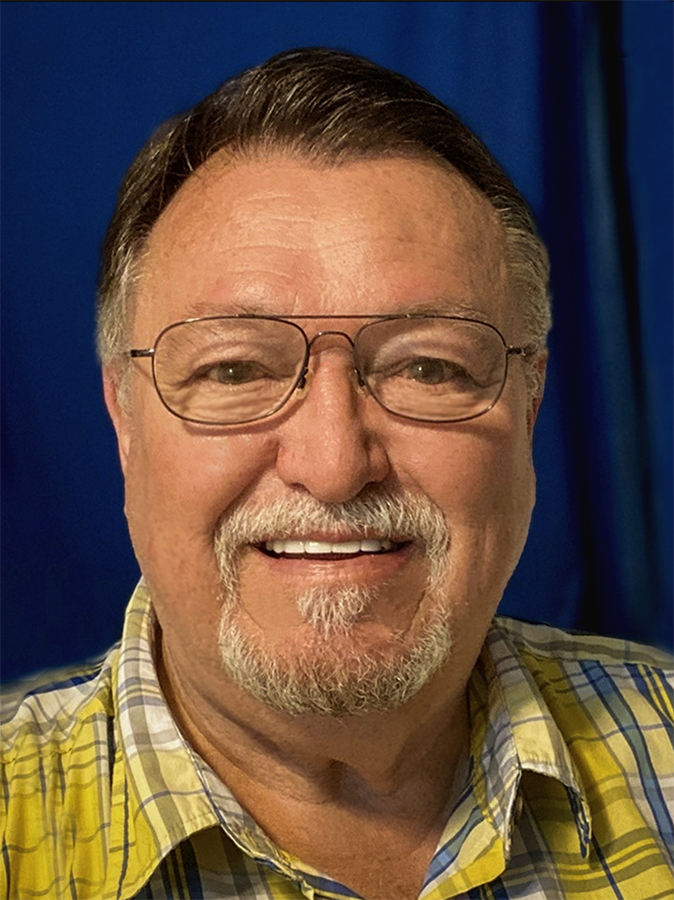
— Interview by Mike (Mikaele) Foley, whose wife Sally Ann McShane Foley, started dancing with Lokelani in the original night show just a few months after the Center opened in 1963. “She and Loke have been good pals ever since, and have always greeted each other warmly. Sally loved dancing in the night show so much that she continued to do it for five years, leaving only when she and I took an extensive trip through many of the Pacific islands,” Mikaele said.
Your comment has been submitted for administrator approval.
Your comment was not saved. Please try again.
No comments yet.