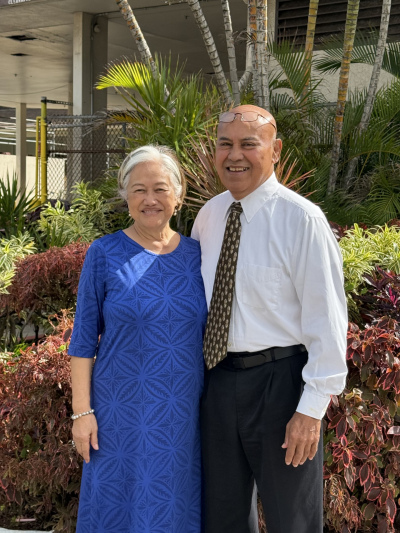
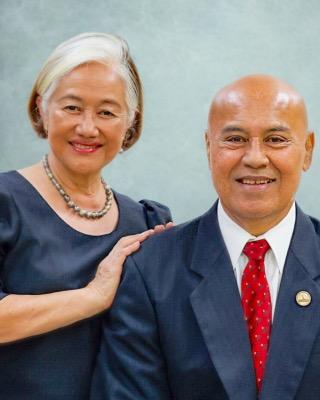
Polynesian Cultural Center alumnus Kalilimoku Sola August Hunt and Tuputausi May Asayo Hirata Hunt, from the Auto Ward in the Pago Pago Samoa Stake, were recently called to serve as temple president and matron of the Pago Pago American Samoa Temple in American Samoa. That tender moment was imprinted forever on their hearts and minds. Sister Hunt recalls the call as a “powerful spiritual experience all by itself.”
Elder D. Todd Christofferson of the Quorum of the Twelve Apostles spoke to them from Salt Lake City, Utah, during a video call while they were at the Hamilton New Zealand Temple.
“I just kept crying, crying, crying,” she shared, overwhelmed by the sacredness of the invitation and unable to speak. “Are you okay, Sister Hunt? Why are you crying?” Elder Christofferson asked gently, to which her husband replied helpfully, “She accepts.”
Their path to this pivotal calling was paved with years of dedication, woven through both Church and civic service. After relocating to American Samoa in 1986, Sister Hunt began working for the local government Senate staff in human resources and compliance, crafting policies and regulations that keep the institution running smoothly.
“I do everything—I’m the secretary, the event planner, the chief of protocol, and the scheduler for the president of the Senate,” she said.
She credits her time at the Polynesian Cultural Center (PCC) for honing the skills and attention to detail needed in this complex role.
“PCC taught me to have an eye for these things… to pay attention to the details, because people notice them.”
Meanwhile, President Hunt’s work at PCC managing daytime activities and the canoe pageant taught him the importance of leadership, respect, and cultural identity. These lessons transferred seamlessly to his roles in government and Church leadership. Together, their PCC experiences provided real-world training in organization, protocol, and cultural presentation that undergirds their faith and service.
The PCC was also a place where they had the unique opportunity to host many dignitaries and prominent leaders. President Hunt fondly remembers welcoming the King and Queen of Tonga, the highest Fijian chief, a prince from Japan, and other international figures. Hosting these dignitaries showcased PCC authenticity to international audiences and validated its mission.
“Every one of these events,” he said, “showed the importance of the Cultural Center and its mission. These occasions helped spread the message that the PCC was not only a cultural showcase but a beacon of Polynesian unity and peace. It took this message out to the world—what the Polynesian Cultural Center is about. I hope it continues to model the vision of bringing all these different cultures together to live without hatred, without wars, without divisions. To me, this cultural center is very, very important. It teaches the world a lesson that all mankind can live together peacefully.”
Board meetings with Church leaders were another facet of their service at PCC. Sister Hunt recalls the inspiring presence of General Authorities and Church leaders during these gatherings as moments of strength and education.
“We’d sit in those meetings, tour with them… The prophet has come through,” she said. “These experiences infused the work of the PCC with gospel perspective and spiritual purpose.”
Their deep-seated connection to Polynesian culture and faith greatly influences their temple service. PCC reinforced a ministry of individual attention—a principle deeply embedded in the new pilot program, Temple Workers Experience. With many new, smaller temples being built throughout the Pacific, they attended this training that was recently held at the Hamilton New Zealand Temple. Sister Hunt explained:
“We were taught to see people as the Savior would… one by one, individually.”
This patient, personalized ministry—taught by Him—is how they will serve temple patrons: carefully noticing needs, offering support, and fostering spiritual growth.
The opening of a new temple on their island promises to deepen this connection for all members. The reduction in travel costs and logistical burdens will allow more members to participate in temple covenants regularly, creating spiritual uplift throughout the community. Currently, excursions to the Apia Samoa Temple in Western Samoa require travel by car, plane, or ferry at considerable time and cost. Sister Hunt shared:
“With the new temple right down the road, our island Saints can come more frequently… strengthen families… and partake of these blessings.”
At the heart of their testimony is the Polynesian concept of ʻohana—the power of extended family. President Hunt, himself the current titleholder of his family, is preparing for another family gathering this year. He remarked:
“We’ve had family reunions since 1940. This will be the 86th year, but without temple sealing, those reunions lose eternal meaning. I’ve always told families that I’ve counseled,’ listen, get to the temple, seal your family’.”
Sister Hunt adds the warmth of Polynesian hospitality:
“The culture of Polynesia teaches us that we’re all extended family. ‘Come, let’s eat. I like your shirt. You want my shirt? I’ll give you my shirt.’” But she emphasizes the eternal dimension: “You secure it in the Lord’s way… in the temple.”
President Hunt remembers the importance of the Laie Temple in his early life:
“We did a lot of baptisms in the temple, so that was my first experience there. I remember my grandfather always talking about ‘going to the temple’ and how they ‘enjoyed their trip to the temple,’ sharing spiritual experiences because of temple attendance. Later, as a young man, I served as an ordinance worker.”
Their story is a beautiful full circle—from youthful days at PCC learning cultural arts and leadership, to refining skills applicable in government and community service, to sacred temple service reflecting profound spiritual growth. Sister Hunt reflected, “Laie wasn’t just a school for you… it was grounds to prepare you to come back and serve your people.”
In Sister Hunt’s final words, the essence of their journey shines through:
“The Lord is in the details. Whether sewing a costume or greeting a temple patron, each small act, infused with love, reflects the Savior’s ministry to each person—one by one.”

No comments yet.